Why commercial roofs fail into the building
A house with a blocked gutter gets a puddle. A building with a blocked scupper gets a ceiling stain three floors down.
Written by Everett Sandlin, Lead Gutter Technician. Reviewed by Boyd Kessinger, Installation Supervisor. Last updated 2026-08-12.
Short answer
Most Knoxville commercial buildings carry a parapet wall with the drainage behind it, usually an internal box channel feeding a small number of leaders. There is no outside edge for water to spill over harmlessly. When something blocks, the level rises across the whole roof until it finds the lowest weakness in the structure, which is why scheduled clearing matters far more on these buildings than on houses.
Parapets, scuppers and box gutters
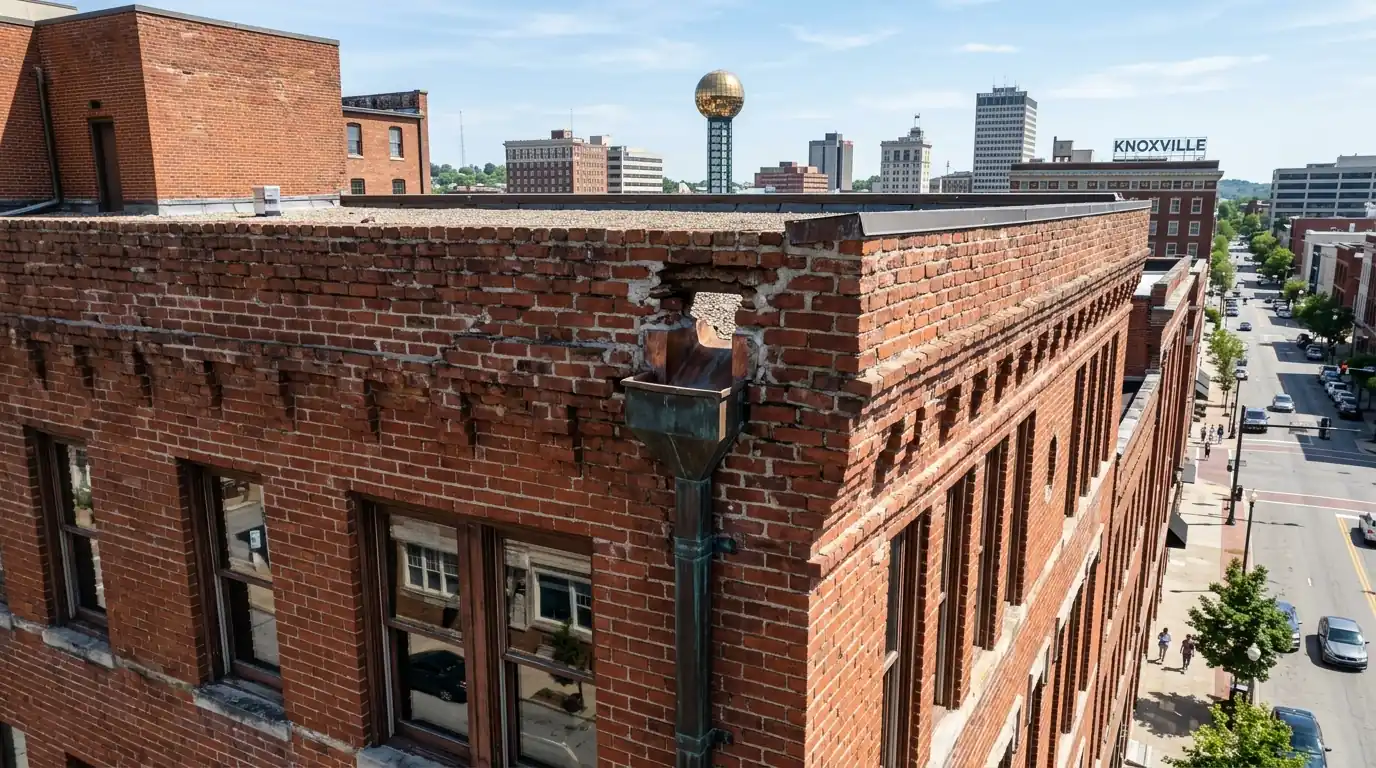
A parapet is a wall carried above the roof line, so water has to get through it rather than over it. Scuppers are the openings that do that, and they are the most commonly blocked element on any commercial roof.
A box gutter is a lined channel built into the roof structure rather than hung off an eave, usually running behind the parapet. Metal or membrane lined, and invisible from the street.
Older buildings frequently carry all of it through very few leaders, sometimes one for a whole elevation. That concentration is why a small blockage produces a serious interior problem.
How they actually fail
The lining is the usual point. Original soldered metal linings split at seams and where the channel changes direction, and a split lining discharges straight into the structure.
Fall is the second. A channel built into a structure settles with the building, and a box gutter that has lost its pitch ponds permanently, which shortens the lining's life further.
The outlet is the third and the most common trigger. These systems carry a whole elevation through one or two openings, so a single blockage backs water along the entire channel.
Why sealing from above is the wrong fix
Running a bead of sealant along a tired metal seam is the classic mistake. The joint keeps moving with temperature, the sealant fails at the same speed the old one did, and meanwhile water keeps reaching the structure.
The honest decision is between local repair and relining, and it turns on how much lining is still sound. One split seam is a repair; failure at several points means the lining has reached its age.
Fall correction is often possible within the existing channel by adjusting the build up, which is far less invasive than altering the structure. Where it is not, saying so is more useful than a repair that will not hold.
What actually protects a building
Scheduled inspection, and it is not an upsell. With this little redundancy the difference between a routine clearing and a flooded tenant space is whether somebody looked at the roof before the storm.
Access planning is the other half. Loading zones, trading hours and neighboring tenants decide when work can happen, and turning up to improvise costs the building more than agreeing a plan in advance.
Documentation matters more than on residential work. Managing agents and owners need a record of what was found and what was done, so photographs and written findings go with every visit.
Who is responsible for what
On a single occupier building the answer is simple. On a converted or multi tenanted one it rarely is, because the roof and the leaders are usually common property while the damage lands inside one unit.
That produces the recurring difficulty: the person with the problem is frequently not the person who can commission the fix. An owner reports it, a managing agent assesses it, and a board approves it on a meeting cycle.
What shortens that considerably is documentation. A written survey with photographs gives a board something concrete to approve rather than a resident's account, and it moves faster than another round of correspondence.
It is also why scheduled maintenance is worth more on these buildings than on any house. When the approval cycle takes weeks, preventing the blockage is the only version that protects the space below.
What to take from this
- A parapet gives water nowhere harmless to spill
- Scuppers are the most commonly blocked element on a commercial roof
- Box gutters are lined channels within the structure, not hung gutters
- Very few leaders means very little margin for one blockage
- Never seal over a tired lining from above
- Scheduled inspection is the whole answer on low redundancy drainage
- Photographs and written findings belong with every visit
Questions this raises
An opening through a parapet wall that lets roof water out. It sits at roof level where nobody looks and collects everything the roof gathers.
Because a parapet gives it nowhere harmless to go. The level rises across the roof until it finds the lowest weakness in the structure.
Often, where a single seam or a local area has failed. Where the lining has failed at several points, relining is the honest answer.
More often than residential, because the consequences are larger. Twice a year is a common baseline and a survey refines it.
Services this relates to
Commercial Gutter Services
The full roof edge picture on a commercial building.
Box Gutter Repair
Internal channels relined or repaired at the seams.
Gutter Inspection Service
A documented survey for the building file.
Gutter Maintenance Plans
Scheduled visits, which is what prevents interior damage.
Roof Debris & Leaf Removal
Clearing flat roofs that feed very few outlets.
Arrange a commercial survey
Tell us the building and the tenancy and we will survey the parapet, the scuppers and every leader.