Commercial Gutter Services in Knoxville, TN
Commercial roof drainage is not a bigger version of a house. Internal gutters, parapets and single leader systems fail differently and need planning before anyone arrives.
How commercial drainage differs
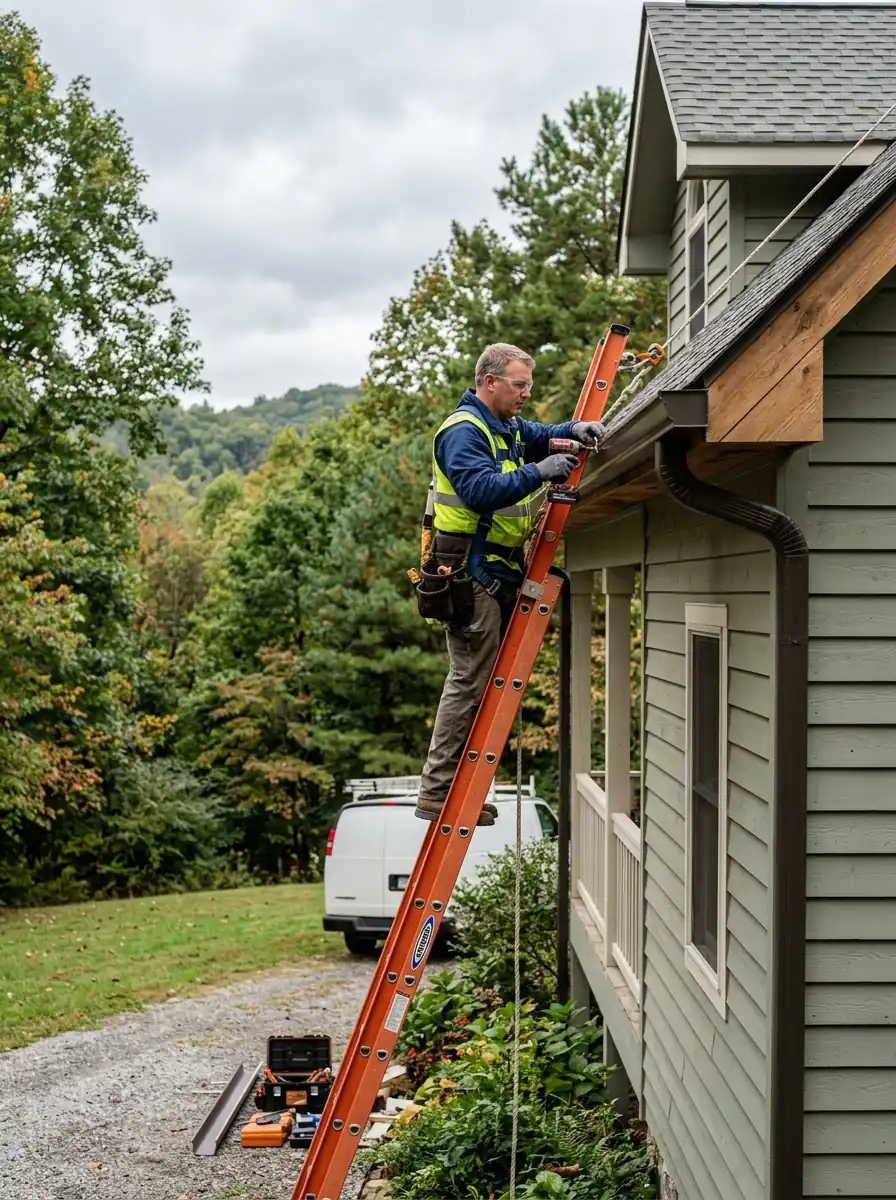
A house sheds water off an open eave into a visible trough. Most commercial buildings in Knoxville carry a parapet wall with the drainage behind it, often an internal box gutter feeding a small number of leaders. That means failures are invisible from the street, and a single blockage can back water across a whole roof rather than spilling harmlessly over an edge.
What commercial work actually involves
Access is the first constraint. Loading zones, metered frontage, trading hours and neighboring tenants all decide when and how the work happens.
The drainage itself is usually concealed. Internal box gutters, scuppers through parapets and original cast leaders each behave differently from a residential system.
Consequences are larger. Water backing up behind a parapet reaches the roof deck and the tenant space below, so scheduled maintenance is worth far more than reactive repair.
Reactive calls against a maintenance schedule
| What it involves | Doing it yourself | Bringing us in |
|---|---|---|
| When problems surface | When a tenant reports a ceiling stain | At a scheduled inspection, before damage |
| Access | Improvised around whoever is trading that day | Agreed in advance with the building |
| Cost pattern | Unpredictable, and highest at the worst moment | Budgeted and level across the year |
| Records | Nothing beyond the invoice | Photographs and findings visit by visit |
What commercial gutter work depends on
Building size and roof edge length
The main driver, measured around the whole perimeter.
Access arrangements
Loading zones, lifts and out of hours working all affect the figure.
Drainage type
Internal box gutters and scuppers take longer than an open eave.
Leader count and condition
Original cast leaders need different handling from modern stock.
Frequency
Scheduled maintenance is priced differently from one off calls.
Height
Multi story elevations need more staging and sometimes lift access.
Documentation required
Building files and managing agents often want formal reporting.
Commercial work varies far more than residential. Scheduled maintenance visits commonly plan from $340 per visit for smaller buildings, with internal box gutter repair well above that. Site specific figures follow the visit.
What planned commercial work gives you
Failures are found before tenants report them
Scheduled inspection beats a call from the unit below.
Work fits around trading
Access is planned rather than improvised on the day.
Concealed drainage gets seen
Internal gutters are invisible until they fail.
One contractor for the whole roof edge
Trough, leaders, scuppers and fascia together.
Records for the building file
Findings documented visit by visit.
Predictable budgeting
Scheduled maintenance costs less than emergency response.
Less disruption below
Water damage in a tenant space costs far more than the drainage work.
Original box gutters on the building?
Internal box drainage on older masonry is specialist work and it is where most downtown failures start.
Parapets, scuppers and internal box gutters
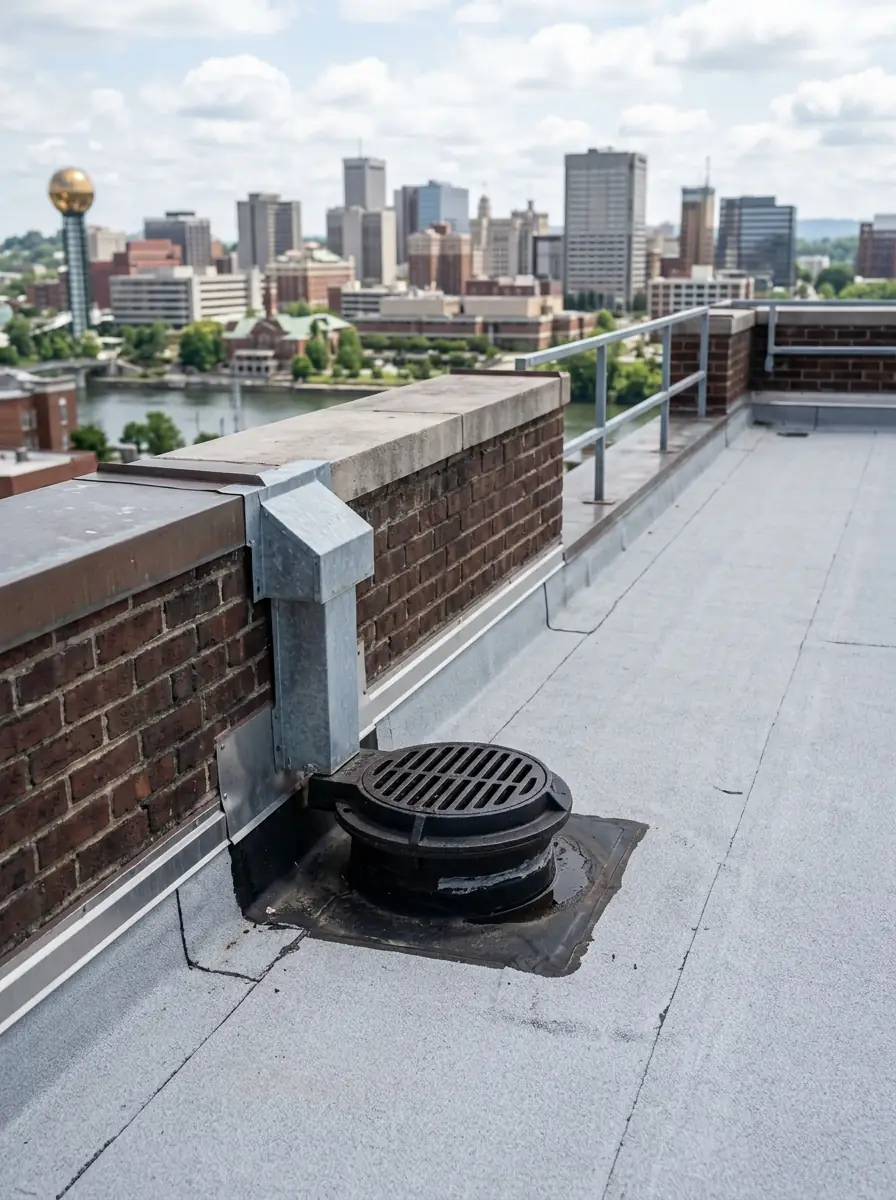
A parapet is a wall carried above the roof line, so the water has to get through it or under it rather than over it. Scuppers are the openings that do that, and they are the most commonly blocked element on any commercial roof.
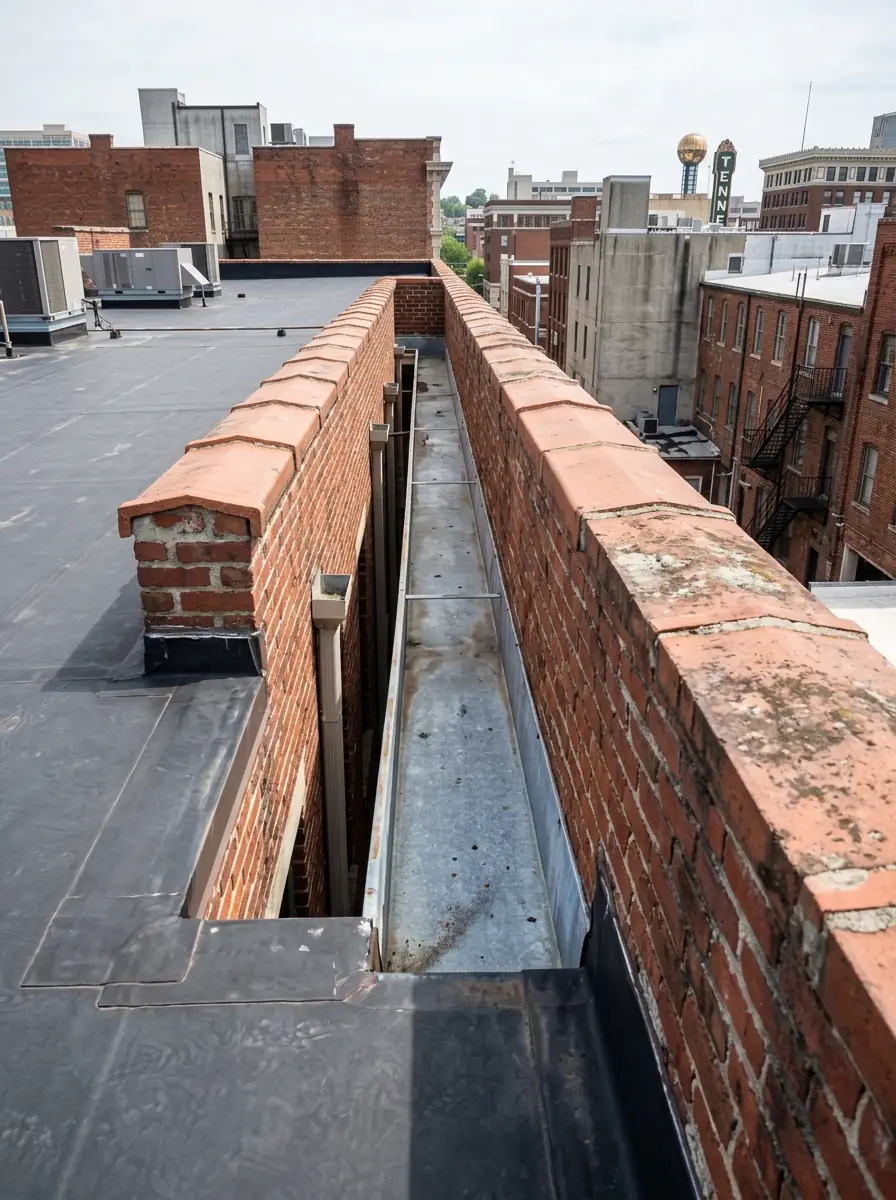
Behind the parapet the drainage is often an internal box gutter, a lined channel running along the roof edge. When one blocks, the water has nowhere to spill except into the building.
Older downtown buildings frequently carry all of it through very few leaders, sometimes a single one for a whole elevation. That concentration is why a small blockage on a Gay Street building can produce a serious interior problem.
Signs a commercial roof is not draining
Staining on an interior ceiling
Water is already past the roof edge and into the structure.
Ponding visible on a flat roof
Drainage is not clearing at the rate the roof delivers.
A scupper that never runs
The opening through the parapet is blocked.
Efflorescence on a parapet wall
Water is moving through the masonry rather than past it.
Overflow at the front of the building
Water is finding the lowest failure point rather than the drain.
Debris visible above the parapet line
Anything you can see from the street is a fraction of what is up there.
Leaders running only during heavy rain
A partial blockage passes light rain and fails in serious weather.
What a commercial visit covers
- Site visit with access, trading hours and staging agreed before scheduling
- Roof edge, parapet and scupper openings inspected
- Internal box gutters checked along their length where present
- Every leader proved with water rather than assumed clear
- Debris cleared and removed from site
- Findings documented with photographs for the building file
- Maintenance interval recommended based on what was found
From site visit to scheduled maintenance
You describe the building
Type, height, tenancy and what has failed before.
We arrange a site visit
Access and timing agreed with you rather than assumed.
The roof edge is surveyed
Parapet, scuppers, box gutters and every leader.
Findings are documented
With photographs suitable for the building file.
A scope is proposed
Immediate work separated from scheduled maintenance.
Work is scheduled around trading
Out of hours where the building needs it.
Drainage is proved
Water through every leader with discharge confirmed.
How long commercial work takes
A survey on a small commercial building is a half day including documentation.
Clearing and proving a full parapet system on a larger building takes one to two days depending on access.
Internal box gutter repair is a different order of work and is scoped separately after the survey rather than estimated from the street.
Knoxville's commercial building stock
The downtown core is the most demanding. Gay Street and Jackson Avenue buildings carry original masonry parapets and internal drainage, with loading zones deciding when anything can happen.
The Magnolia and Western Avenue corridors are the other concentration, where storefront blocks in Burlington and Marble City carry simpler drainage but almost no side yard for staging.
Out west the picture changes entirely. Cedar Bluff and Hardin Valley commercial buildings are newer, with conventional roof edges and parking that makes access straightforward.
Where we take commercial gutter services calls
Commercial Gutter Services is available across these Knoxville area ZIP codes and the towns around them.
- Bearden (37919)
- West Hills (37909)
- Fountain City (37918)
- Sequoyah Hills (37919)
- Cedar Bluff (37923)
- Hardin Valley (37932)
- Karns (37931)
- Halls Crossroads (37938)
- Powell (37849)
- South Haven (37920)
- Downtown Knoxville (37902)
- Holston Hills (37914)
- Rocky Hill (37919)
- Inskip (37912)
- Farragut (37934)
- Maryville (37804)
- Oak Ridge (37830)
- Alcoa (37701)
How we work on occupied buildings
Access planned before scheduling
Turning up and improvising costs the building more than it costs us.
Concealed drainage actually inspected
Internal box gutters are invisible until they fail, so they get looked at deliberately.
Every leader proved with water
On a single leader elevation, assuming is not good enough.
Findings documented
Managing agents need a record, not a verbal summary.
Commercial questions from Knox County
Yes. Access and timing are agreed in advance, including out of hours where trading makes that necessary.
An opening through a parapet wall that lets roof water out. It is the most commonly blocked element on a commercial roof.
More often than residential in this county, because the consequences are larger. Twice a year is a common baseline and the survey refines it.
Yes. Findings and photographs are provided visit by visit in a form managing agents can file.
Yes, and they are where most downtown failures originate. They are surveyed and scoped separately because the work is specialist.
Yes, where the building requires it. It affects the figure and is agreed at the site visit rather than sprung later.
We schedule recurring visits at an agreed interval. The interval follows what the survey finds rather than a standard offer.
We will say so plainly. Roof covering work belongs with a commercial roofer and we will not pretend otherwise.
Commercial work that fits together
Box Gutter Repair
Internal drainage on older masonry buildings.
Steel Gutter Installation
Where impact resistance matters at the gutter line.
Gutter Maintenance Plans
Recurring visits at an agreed interval.
Gutter Inspection Service
A documented survey without committing to work.
Roof Valley Drainage Repair
Where roof planes converge and concentrate flow.
Arrange a commercial site visit
Tell us the building type, height and tenancy, and we will survey the roof edge and document what we find.