Underground Downspout Drainage in Knoxville, TN
A downspout that empties beside the foundation has moved the problem a few inches. A buried line carries it to ground that can actually take it.
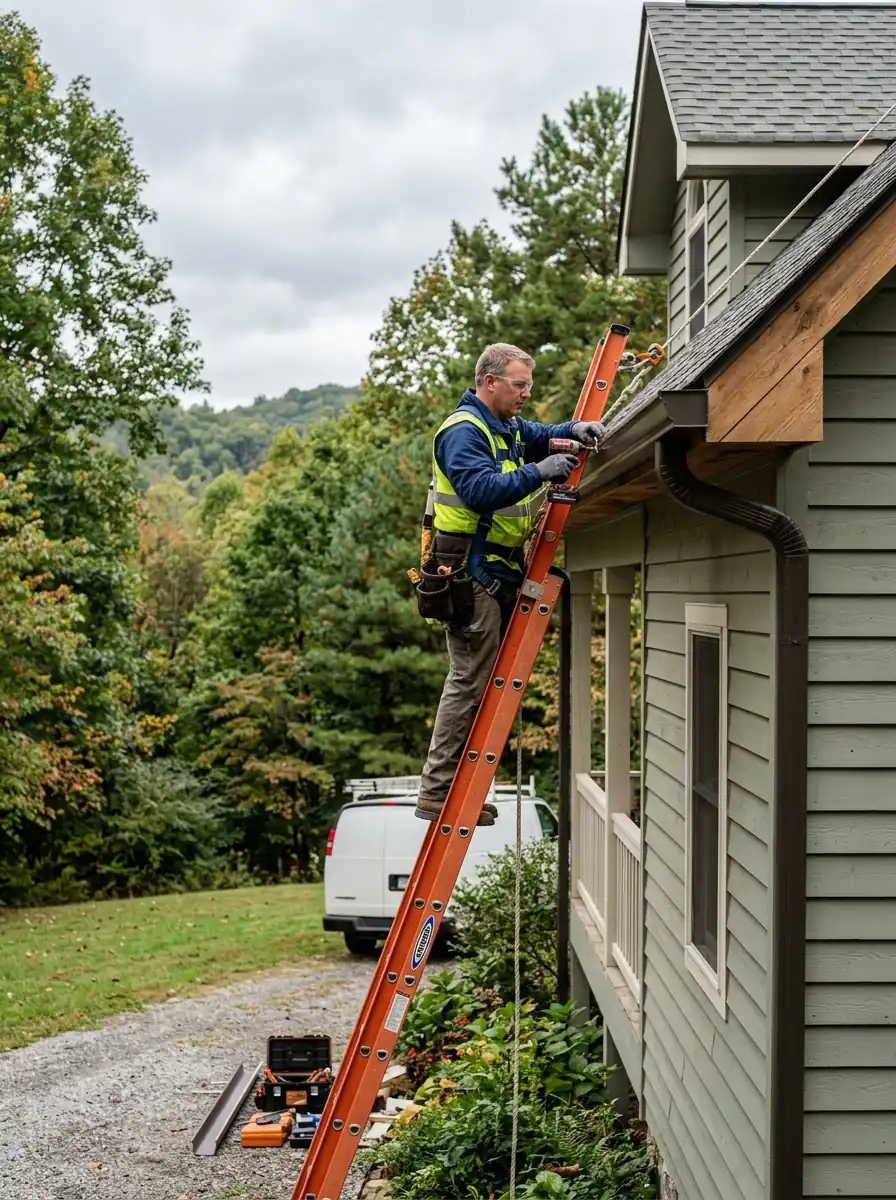
Why splash blocks fail on Knoxville lots
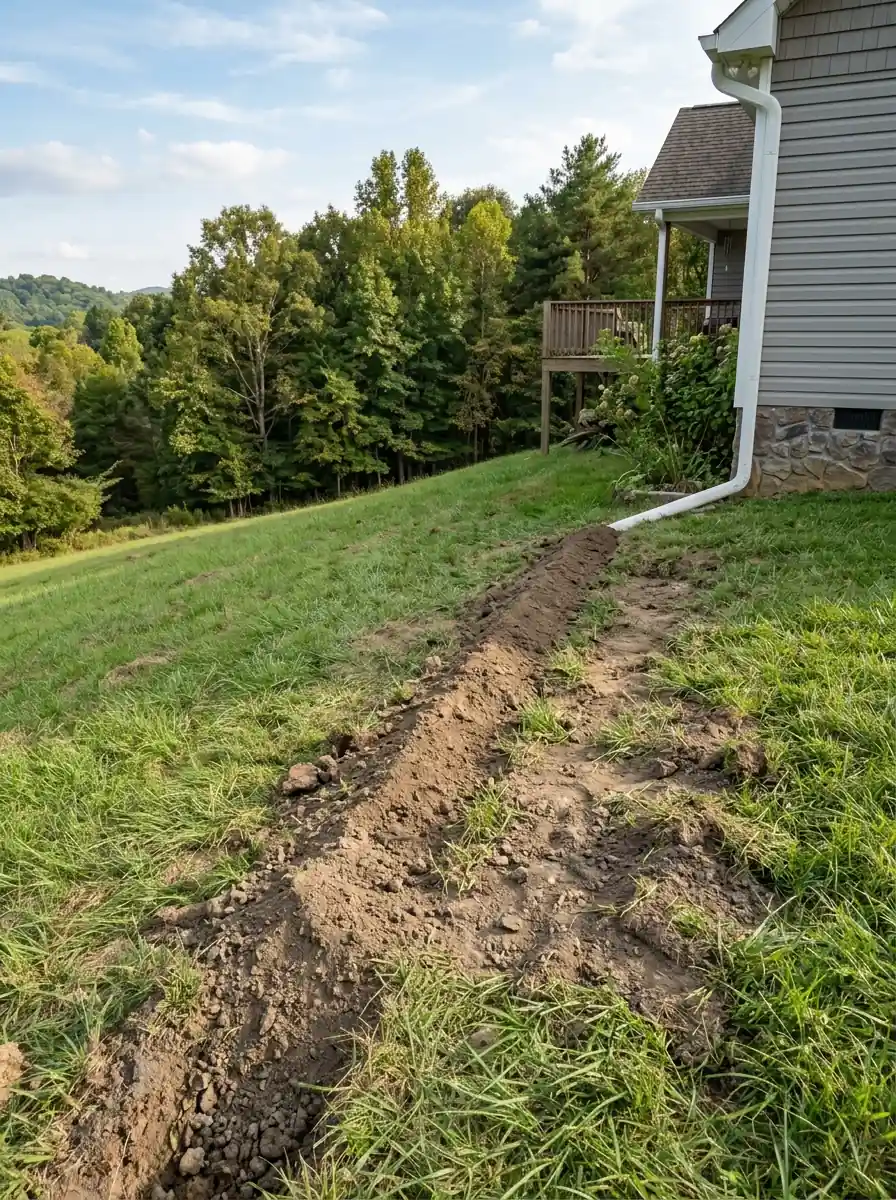
Red clay drains slowly, so water released next to the house sits and soaks rather than running off. On sloped lots the opposite happens and the discharge cuts a channel toward whatever is downhill. A buried line takes the whole roof volume to a chosen discharge point, either a pop up emitter on flat ground or a daylight outlet on a slope.
What a buried line is and is not
A buried downspout line is solid pipe from the leader to a chosen discharge point. It carries roof water only, and its job is distance rather than absorption.
A French drain is a different thing entirely. That is perforated pipe in gravel designed to collect groundwater, and connecting a roof leader into one usually overwhelms it.
The two are often combined on the same property, with roof water buried and carried away while a separate perforated run handles the wet ground. Keeping them separate is what makes both work.
Extending on the surface against burying the line
| What it involves | Doing it yourself | Bringing us in |
|---|---|---|
| Distance achieved | A few feet, until the extension gets moved | As far as the grade and the discharge point allow |
| Survivability | Mowed over, kicked, cracked in frost | Below grade and out of the way |
| Appearance | Visible pipe across the lawn | Nothing above ground but the outlet |
| Servicing | Nothing to service, nothing to rely on | Cleanouts fitted so the run can be rodded |
What a buried drainage price depends on
Trench length
The main driver, measured from each leader to its discharge point.
Number of leaders connected
Each downspout brought into the system adds pipe, fittings and trench.
Ground conditions
Rock and heavy clay slow trenching considerably compared with loam.
Discharge type
A daylight outlet on a slope is simpler than a pop up emitter set in a lawn.
Obstacles crossed
Driveways, walkways and mature root systems all add time and sometimes method.
Cleanout count
Access points make the line serviceable and are worth the small extra.
Reinstatement
Turf, beds and hard surfaces put back properly is part of the job, not an afterthought.
Buried downspout lines in this market commonly plan at $16 to $34 per linear foot depending on ground conditions and reinstatement, with rock and driveway crossings above that. Planning ranges rather than quotes.
What burying the line changes
Water leaves the foundation zone
The whole roof volume is carried past the backfill rather than released into it.
Nothing to trip over
Surface extensions get moved, mowed over and broken. A buried line stays where it was put.
Erosion stops
Concentrated discharge on a slope cuts fast, and a buried run ends it at the source.
Beds and mulch stay put
Planting under a downspout washes out every storm until the water is routed.
Crawlspaces stay drier
Most standing water under a Knoxville house arrives from the roof, not the water table.
The lawn stops rutting
A single discharge point on clay creates a permanent soft patch.
It can be cleaned
With cleanouts fitted at the right points, a buried line is serviceable rather than sealed.
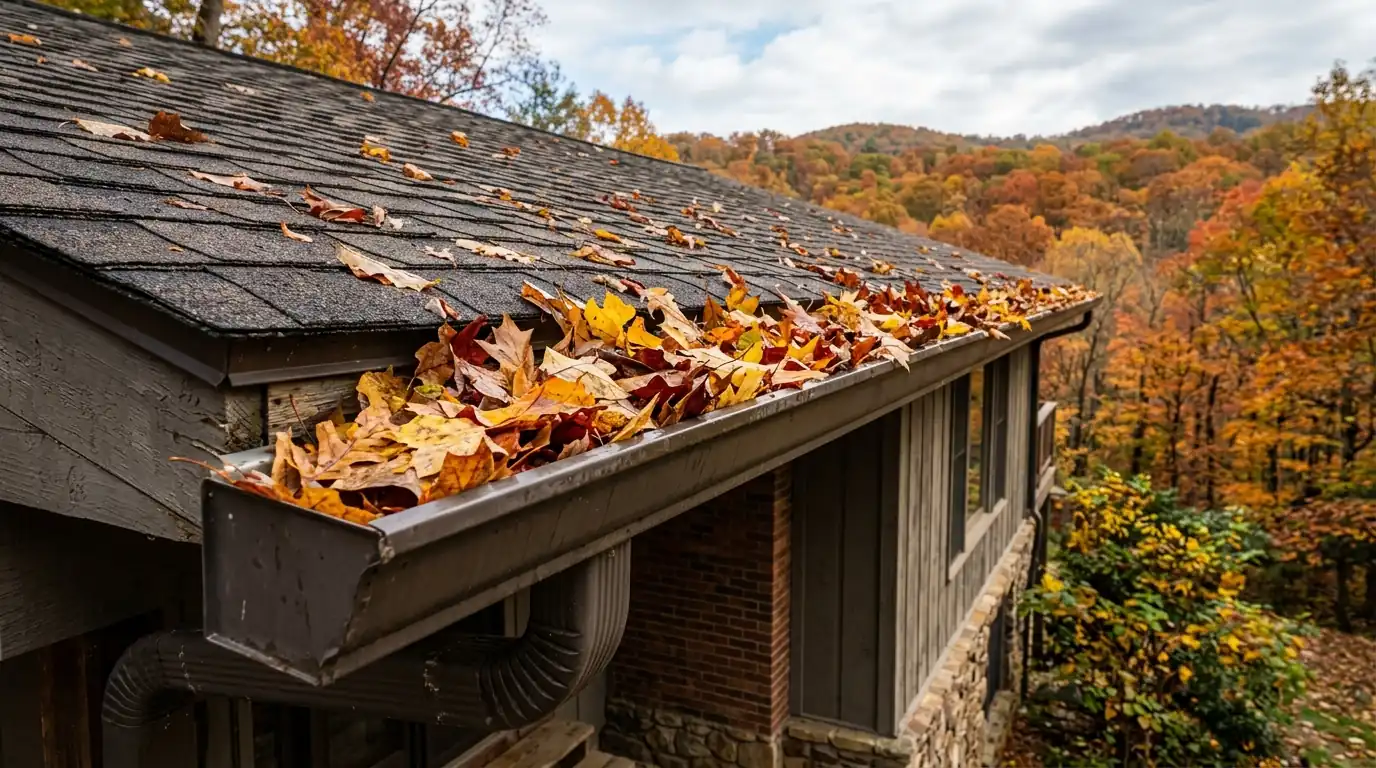
Wet ground as well as roof water?
Groundwater needs a perforated run of its own. Mixing the two overwhelms both.
Choosing the discharge point
The discharge point is the whole design. Everything else is trenching, and choosing badly means the water simply arrives somewhere else that cannot take it.
On sloped lots a daylight outlet is best. The line runs downhill to an open end at a bank or a swale, gravity does the work, and there is nothing to block or fail.
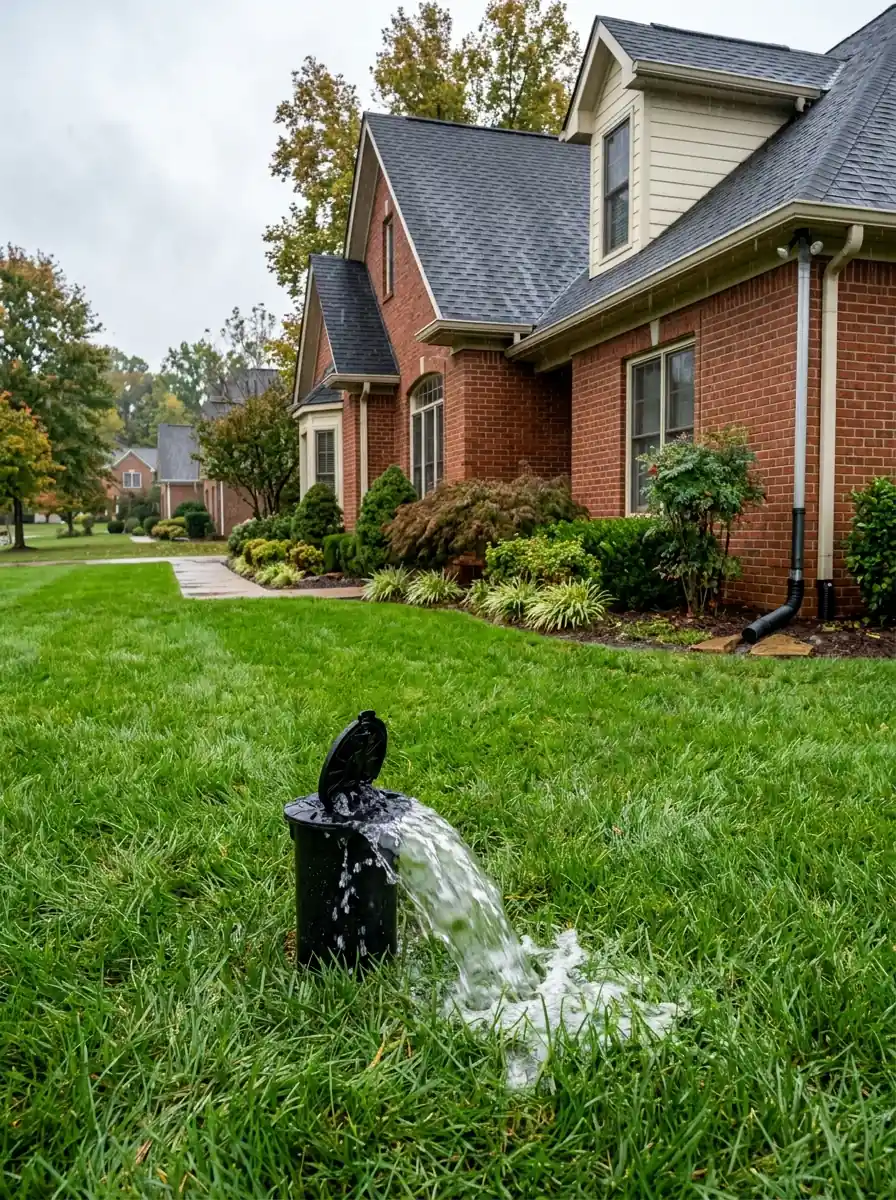
On flat ground a pop up emitter is the usual answer. The lid lifts under flow and closes after, which keeps debris and mowers out. Both need the line pitched properly, because a buried run that holds water silts up from the inside.
Signs the discharge point is wrong
Standing water at the downspout
Clay is refusing the volume being released into it.
A channel cut across the lawn
Discharge on a slope is eroding a path toward the low ground.
Mulch washed out of a bed
The bed under the leader is taking the whole roof plane.
Damp in a crawlspace after rain
Roof water is soaking into the backfill beside the foundation.
Extensions broken or moved
Surface pipe never survives mowing for long.
Water pooling against a neighbor boundary
Discharge is being carried onto ground that is not yours.
A soft patch that never dries
One permanent wet spot marks where the leaders empty.
What a buried line installation includes
- Survey of grade, discharge options and existing drainage
- Utility locate arranged before any digging
- Route marked and agreed with you before the trench opens
- Solid pipe run from each leader with pitch to the outlet
- Cleanout fitted where the run allows future servicing
- Pop up emitter or daylight outlet set at the chosen point
- Trench backfilled, turf reinstated, and the line flushed and watched
From the survey to the flush test
You describe the problem
Where water sits, where it runs, and what it has already damaged.
We walk the grade
Discharge options are found on site, because the low ground decides the design.
Utilities are located
Marked before any spade goes in the ground.
The route is agreed
Marked out so you can see exactly where the trench will run.
Pipe is laid to pitch
Solid line from each leader with fall maintained to the outlet.
Discharge is set
Pop up emitter or daylight outlet, chosen for the grade you actually have.
Everything is reinstated and flushed
Turf back, then water through the line while the outlet is watched.
How long a buried line takes to install
A single leader to a nearby daylight outlet is usually a half day including reinstatement.
Connecting three or four downspouts across a typical lot takes one to two days, depending on trench length and how much rock turns up.
Driveway or walkway crossings add time and sometimes a different method. Those are identified at the survey rather than discovered mid trench.
Clay, slope and what they do to roof water
Knox County red clay is the constant. It holds water rather than taking it, so volume released beside a foundation stays in the backfill zone where it does the most harm.
Slope is the second variable and it cuts both ways. On the hillside streets around Sterchi Hills and Kimberlin Heights gravity gives you an easy daylight outlet, but unmanaged discharge erodes fast on the way there.
Flat lots need the emitter approach instead. Streets around Inskip, Norwood and the bottomland near Island Home have very little fall, so the design is about reaching ground that can accept the water rather than about speed.
Where we take underground downspout drainage calls
Underground Downspout Drainage is available across these Knoxville area ZIP codes and the towns around them.
- Bearden (37919)
- West Hills (37909)
- Fountain City (37918)
- Sequoyah Hills (37919)
- Cedar Bluff (37923)
- Hardin Valley (37932)
- Karns (37931)
- Halls Crossroads (37938)
- Powell (37849)
- South Haven (37920)
- Downtown Knoxville (37902)
- Holston Hills (37914)
- Rocky Hill (37919)
- Inskip (37912)
- Farragut (37934)
- Maryville (37804)
- Oak Ridge (37830)
- Alcoa (37701)
How we keep a buried line serviceable
The discharge point is chosen first
Everything else is trenching. The outlet is the actual design decision.
Roof water kept separate
Connecting leaders into a groundwater drain overwhelms it in the first real storm.
Cleanouts fitted
A buried line without access is a line nobody can service.
Route agreed before digging
You see the marked run and the outlet position before the trench opens.
Buried drainage questions from Knox County
Far enough to leave the backfill zone, which on clay usually means well past the typical four foot splash block. The grade decides the rest.
Sometimes, subject to local rules and the curb arrangement. A daylight outlet on your own low ground is usually simpler.
Rarely a problem at Knoxville winter temperatures when the line is pitched and drains fully after each storm.
Best avoided. Roof volume overwhelms a system built to collect groundwater slowly, and both then underperform.
With cleanouts fitted it is rodded like a downspout. Without them the whole line has to be excavated, which is why we fit them.
Yes. Trenches are backfilled and turf reinstated as part of the job rather than left for you.
Yes, though the method and cost depend on the surface. It is identified at the survey rather than discovered mid trench.
Often it is most of the fix, because most crawlspace water here arrives from the roof rather than the water table. A survey tells you which.
Drainage work often done together
French Drain Installation
Perforated pipe for groundwater, kept separate from roof water.
Downspout Extension Installation
The surface option where burying the line is not practical.
Yard Drainage Correction
Grading and swales where the ground itself holds the water.
Downspout Installation
New leaders sized and placed before anything gets buried.
Gutter Slope Correction
A run that ponds delivers nothing to the drain below it.
Get the roof water routed away
Tell us where the water sits and we will walk the grade and show you where it should discharge.