Downspout Extension Installation in Knoxville, TN
An extension is the simplest way to move discharge away from a wall. Where burying a line is impractical, it is often the whole answer.
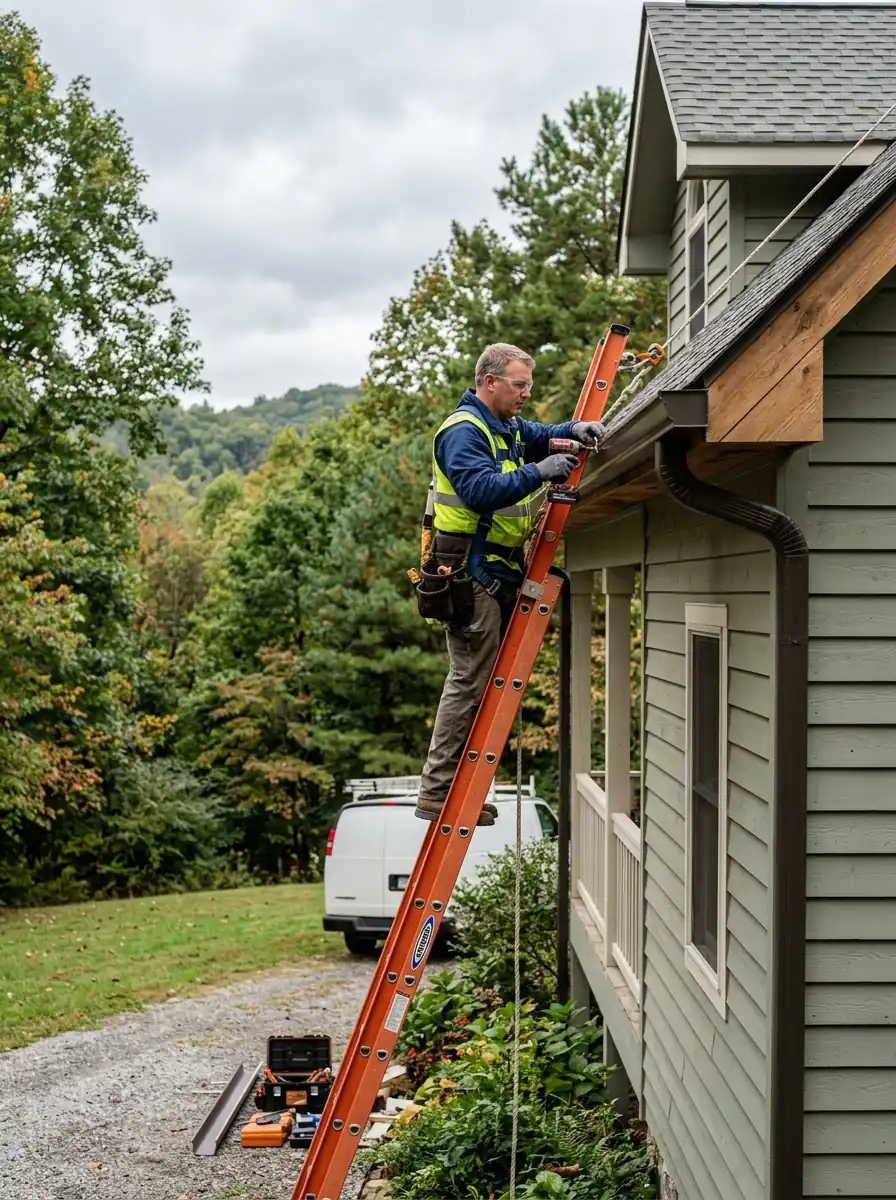
How far roof water needs to go
Far enough to clear the backfill zone around the foundation, which on Knox County clay usually means well past the four foot splash block most homes have. The exact distance depends on the grade: on ground that falls away, six feet may be plenty; on flat ground the water has to reach somewhere it can actually soak away or run off.
Extension types and where each suits
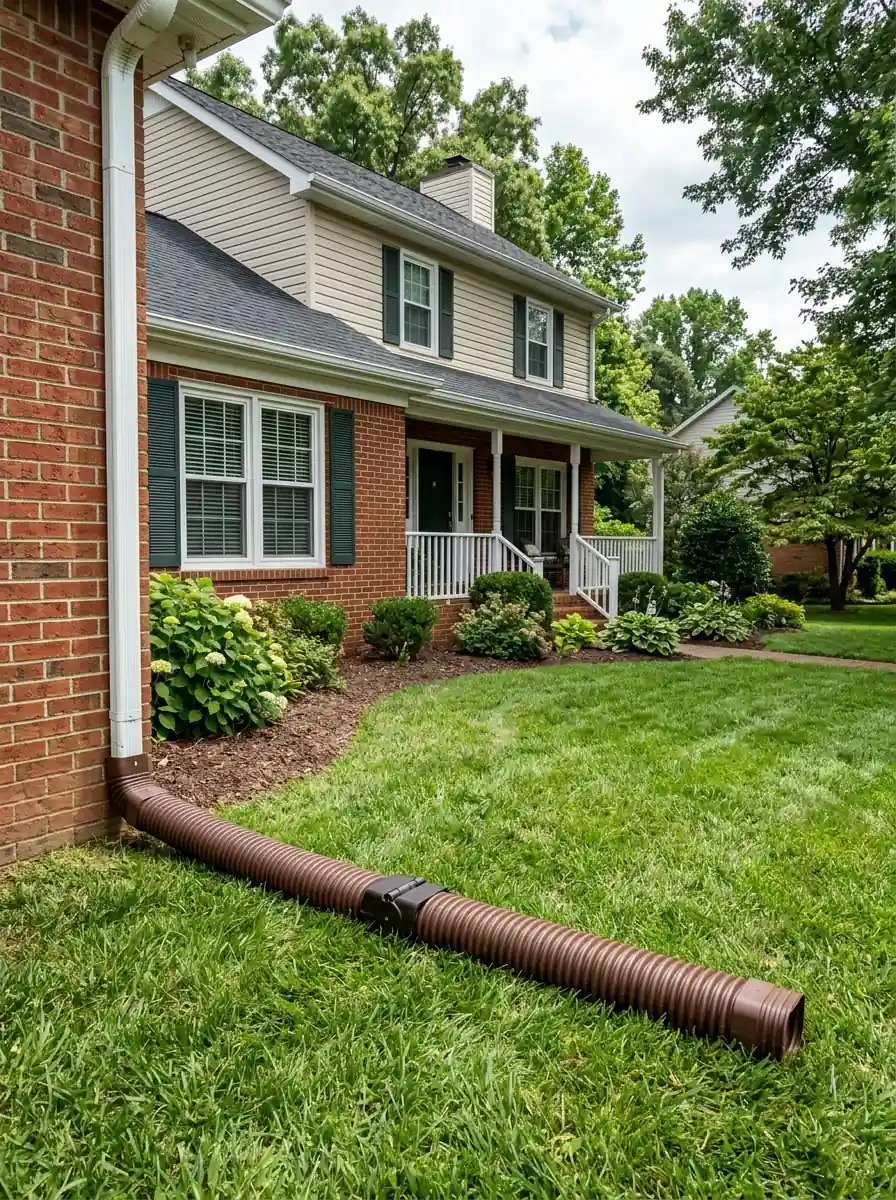
Rigid extensions are lengths of downspout run out at grade. They move the most water cleanly and they stay where they are put.
Hinged and flip up extensions lift for mowing and drop back afterward. They suit lawn areas where a fixed run would be in the way every week.
Roll out sleeves are the cheapest and the least durable. They work as a stopgap and they rarely survive more than a couple of seasons of mowing and sun.
A splash block against a proper extension
| What it involves | Doing it yourself | Bringing us in |
|---|---|---|
| Distance achieved | Around four feet, into the backfill zone | As far as the grade needs, past the fill |
| Erosion at the landing point | Concentrated at one spot close to the wall | Spread further out on ground that can take it |
| Durability | Kicked out of position constantly | Fixed or hinged and staying where it was set |
| Mowing | Mower has to work around it | Hinged options lift and drop back |
What extension work depends on
Number of leaders extended
The main driver, counted across the house.
Extension length
Longer runs cost more in material and take longer to set.
Type chosen
Rigid is cheapest per foot, hinged costs more and survives mowing.
Ground conditions at the outlet
Where the landing point needs a splash pad or gravel.
Routing obstacles
Paths, beds and steps all affect the run.
Color matching
Matching an existing leader finish rather than using stock.
Whether a buried line is better
Sometimes the honest answer, and it is priced differently.
Extensions commonly plan at $45 to $135 per leader in this market depending on length and type. Planning ranges rather than quotes.
What extensions change
Water clears the backfill
The zone right against a foundation is the worst place to release it.
Erosion moves away from the wall
Discharge lands where the ground can take it.
Beds stop washing out
Planting directly under a leader takes the whole roof plane.
Crawlspaces get drier
Most water under a Knoxville house arrived from the roof.
Cheap and immediate
The lowest cost drainage improvement available.
Reversible
Nothing is buried, so the arrangement can be changed later.
Mowing stays easy
Hinged options remove the weekly obstacle.
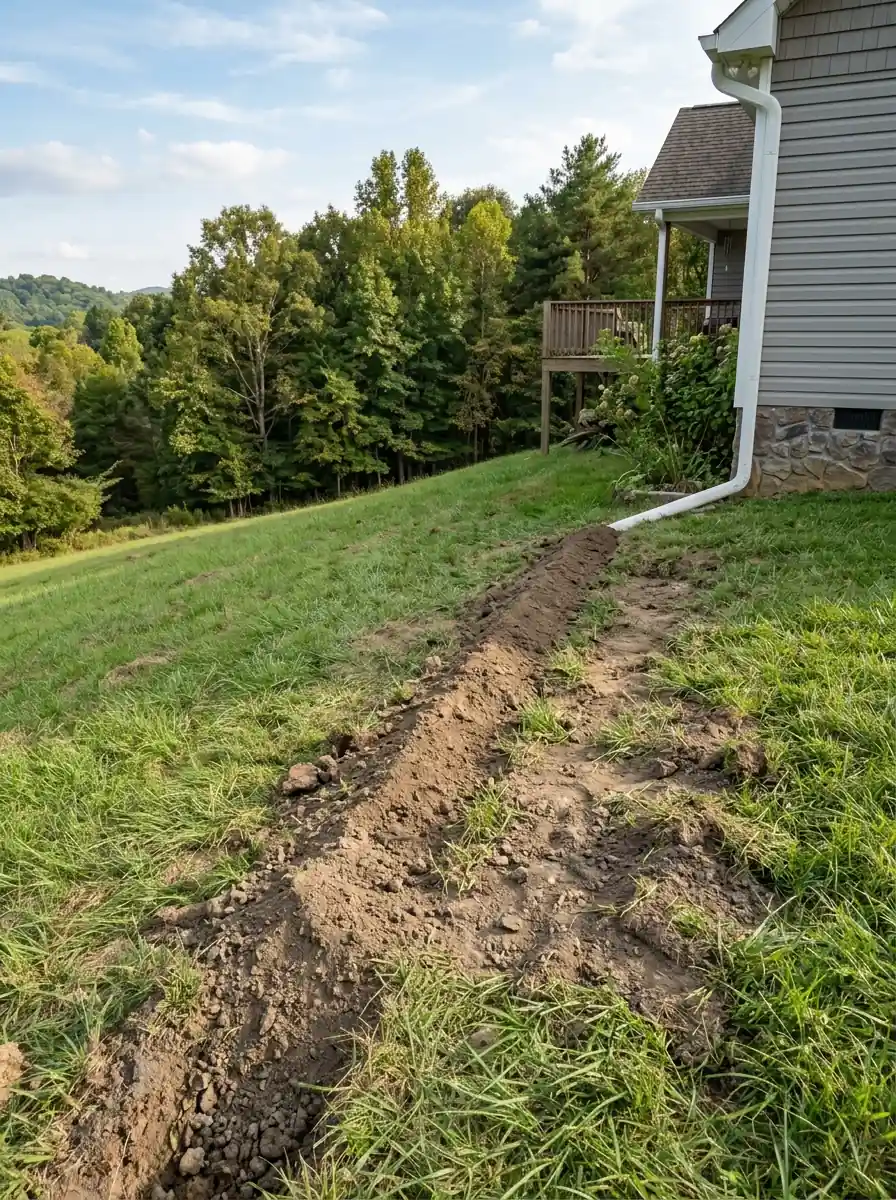
Extension not far enough?
On flat clay lots the water sometimes has to go further than an extension can sensibly reach.
Choosing between an extension and a buried line
Extensions win on cost, simplicity and reversibility. Nothing is dug, nothing is hidden, and the arrangement can be adjusted after you have watched a few storms.
Buried lines win on distance and appearance. Where the water has to travel twenty feet or cross an area you actually use, a surface extension becomes an obstacle rather than a solution.
The deciding question is usually the grade. On a lot that falls away from the house, a short extension does the job completely. On flat ground where the water has to reach a specific outlet, burying it is the honest recommendation and we will say so.
Signs the discharge is too close
A trench worn beside the foundation
Discharge is landing in the backfill zone.
Mulch washed out of one bed
That bed is taking a whole roof plane.
Splash marks up the wall
Water is hitting hard close in.
A splash block that has moved
They shift, and once moved they do nothing.
Damp in a crawlspace after storms
Roof water is soaking into the fill beside the wall.
Standing water at the leader
Clay cannot take the volume where it is being released.
Settling soil against the house
Repeated saturation compacts and drops the fill.
What an extension installation includes
- Grade checked at each leader to see where water actually goes
- Extension type chosen for the surface it crosses
- Length set from the grade rather than a standard figure
- Routing agreed so it does not obstruct paths or mowing
- Connection at the leader made so it cannot pull apart
- Landing point protected with a splash pad or gravel where needed
- Water run through each leader with the discharge watched
From grade check to proven discharge
You describe the problem
Where water pools or where the ground is washing.
The grade is checked
At each leader, because every elevation is different.
Type and length are chosen
Rigid, hinged or buried, with the reason.
Routing is agreed
So the run does not become a weekly obstacle.
The extension is fitted
Connected so it cannot pull apart at the leader.
The landing point is prepared
Splash pad or gravel where the discharge would cut ground.
Discharge is proved
Water through each leader with the outlet watched.
How long extension work takes
Fitting extensions to two or three leaders is usually a single short visit.
A full house takes a few hours including checking the grade at each elevation.
Where the grade turns out to need a buried line instead, that is scoped separately rather than forced into the same visit.
Clay, slope and discharge distance
Clay is why four feet is not enough here. Knox County soil absorbs slowly, so water released close in sits in the backfill rather than soaking away.
On the hillside streets around Sterchi Hills and Kimberlin Heights the grade does most of the work, and a short extension often finishes the job completely.
Flat ground is the harder case. Around Inskip, Norwood and the bottomland near Island Home Park there is very little fall, and extensions frequently need to give way to buried lines.
Where we take downspout extension installation calls
Downspout Extension Installation is available across these Knoxville area ZIP codes and the towns around them.
- Bearden (37919)
- West Hills (37909)
- Fountain City (37918)
- Sequoyah Hills (37919)
- Cedar Bluff (37923)
- Hardin Valley (37932)
- Karns (37931)
- Halls Crossroads (37938)
- Powell (37849)
- South Haven (37920)
- Downtown Knoxville (37902)
- Holston Hills (37914)
- Rocky Hill (37919)
- Inskip (37912)
- Farragut (37934)
- Maryville (37804)
- Oak Ridge (37830)
- Alcoa (37701)
How we route an extension
Length set from the grade
A standard four foot figure is not an answer on clay.
Routing agreed with you
An extension that obstructs mowing gets moved and stops working.
Connection made secure
Extensions that pull apart at the leader are the usual failure.
Honest when burying is better
On flat lots we will recommend the more expensive option.
Extension questions from Knox County
Past the backfill zone around the foundation. On clay that usually means well beyond the four foot splash block most homes have.
Yes, where mowing matters. They lift for the mower and drop back, which is why they survive where rigid runs get kicked out of place.
Often it is most of the fix, because most crawlspace water here arrives from the roof rather than the water table.
Yes, and on flat lots or long runs that is usually the better answer. It is a different job and priced accordingly.
As a stopgap. They rarely survive more than a couple of seasons of mowing and sun.
Rigid extensions can be matched to the existing leader finish. Hinged products come in a narrower range.
Somewhere the ground can take it and away from paths, neighboring boundaries and anything that ices in winter.
The parts are simple. The judgment about length and landing point is what people usually get wrong, and it is the part that matters.
Drainage work that fits together
Underground Downspout Drainage
Where the water needs to travel further than a surface run.
Downspout Installation
Leader placement decides where the volume lands.
Yard Drainage Correction
Grading and swales where the ground itself holds water.
Downspout Repair Service
Repairing the leader the extension connects to.
French Drain Installation
Groundwater rather than roof water needs its own system.
Get the discharge moved away
Tell us where the ground is washing or pooling and we will check the grade at each leader.