When the roof edge is part of the architecture
On most houses a gutter is a functional item nobody looks at. On some Knoxville streets it is a visible detail, and that changes the specification entirely.
Written by Landon Crutchfield, Senior Estimator. Reviewed by Boyd Kessinger, Installation Supervisor. Last updated 2026-08-12.
Short answer
Half round is what most Knoxville homes built before 1940 originally carried, and on those houses a modern K style profile reads wrong however well it is installed. Copper adds soldered joints instead of sealed ones and commonly serves fifty years or more. Both belong where the roof edge is seen: Sequoyah Hills, the historic districts north of downtown, Holston Hills. On a standard suburban elevation the money buys appearance nobody is looking at.
Why half round rather than K style
K style has a flat back and a decorative front face. It suits mid century and modern houses and it holds more water per inch of width, which is why it became standard.
Half round is a simple open semicircle. It carries roughly twenty percent less at the same nominal size, it costs more, and it is the correct detail on Victorian, Craftsman and the 1920s and 1930s revival styles.
It also handles debris better. A curved bottom carries stems toward the outlet where a flat one lets them settle, which is a genuine functional advantage under canopy.
What copper actually buys
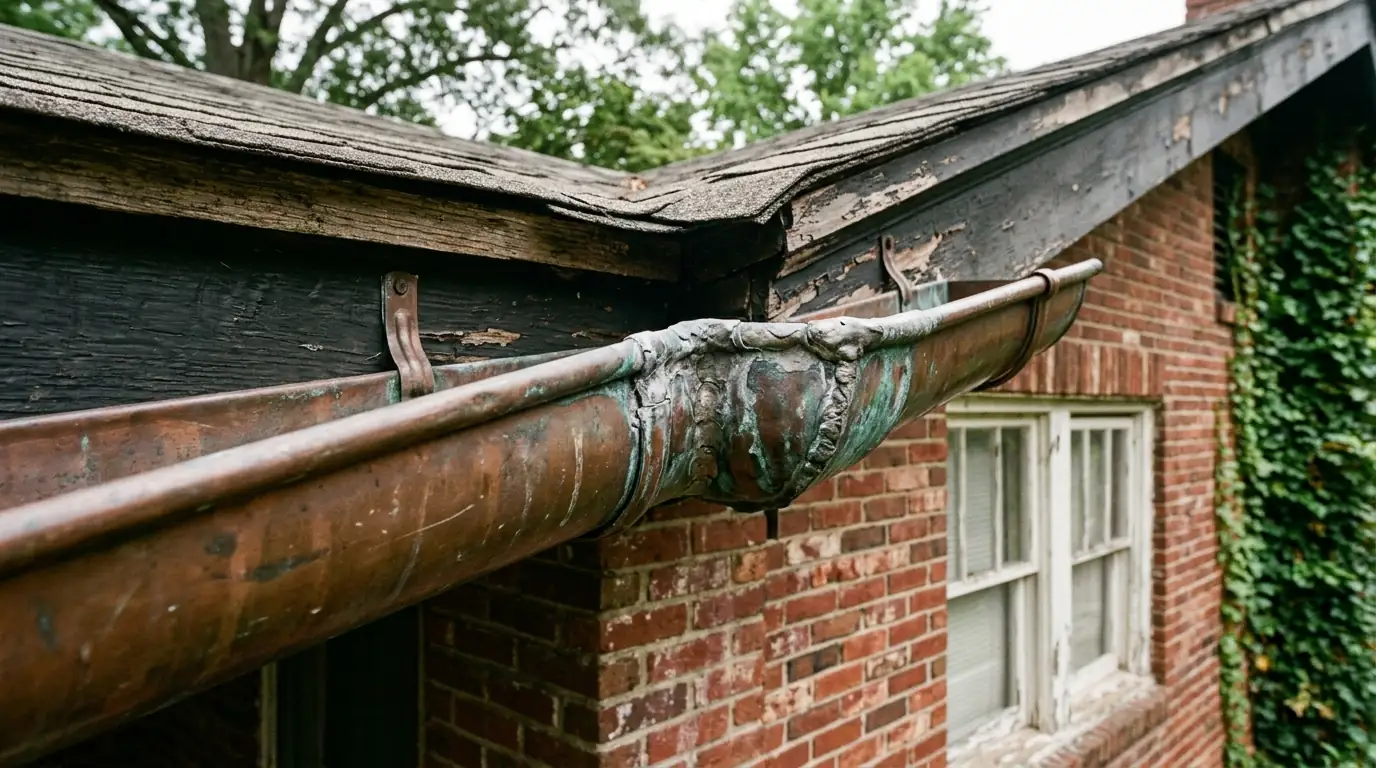
Soldered joints rather than sealed ones. That is the substantive difference: there is no sealant with a service life, so the joint is as permanent as the metal around it.
Service life follows from that. Fifty years or more is normal for a well built copper system, which is why so many Sequoyah Hills houses still carry their originals.
Appearance is the rest. Copper weathers from bright through brown to green patina over decades, at different rates on different elevations, and that unevenness is normal rather than a fault.
The practical catches
Capacity is the first. Half round carries less than K style of the same nominal size, so matching the old size on a roof that has been extended under sizes it. Going up a size is frequently part of the specification.
Mixed metal is the second and it is the trap on this stock. Past repairs have often spliced aluminum into copper systems, and the two corrode where they touch. Putting a copper system back to copper throughout is part of the repair.
Runoff staining is the third. Copper runoff marks light masonry and painted surfaces below it, effectively permanently, so discharge points get planned rather than discovered.
When to say no
On a standard suburban elevation, copper is money spent on something nobody looks at. We would rather say that than take the order.
Where an exact historic profile is unavailable in stock, custom fabrication is possible but the lead time is longer, so it belongs in a planned project rather than a hurried one.
Where the fascia behind the run has failed, none of this matters yet. Board work comes first regardless of what is going on it.
Living with copper over time
New copper is bright and stays that way for months rather than years. It darkens through browns over several years and reaches green patina over decades, and the timeline varies by elevation.
Uneven weathering is normal and worth expecting. A shaded north elevation under canopy and a south facing run in full sun will not match for years, which surprises people who were expecting uniformity.
Keeping it bright is possible with a lacquer, but the lacquer itself needs periodic renewal and it looks wrong on a period house. Most owners let it weather, which is what the material is designed to do.
Theft is worth a thought on unoccupied or secluded properties. Copper carries real scrap value, and that is a practical consideration rather than a scare.
What to take from this
- Half round is the correct detail on most pre 1940 Knoxville houses
- It carries about twenty percent less than K style at the same size
- Copper's real advantage is soldered joints rather than sealed ones
- Uneven weathering across elevations is normal, not a fault
- Never splice aluminum into a copper system
- Copper runoff stains light masonry permanently, so plan the discharge
- On a standard suburban elevation, neither is worth the money
Questions this raises
Usually yes. Copper commonly serves fifty years or more, and a sound system of that age is better repaired in kind than replaced.
Yes, roughly twenty percent less at the same nominal size. Sizing up is often part of the specification.
No. Dissimilar metals corrode where they touch, so a copper system uses copper or brass throughout.
Runoff can mark light masonry and painted surfaces, and the marking is effectively permanent. Discharge points are planned with that in mind.
Services this relates to
Half Round Gutter Installation
The profile that reads correctly on period architecture.
Copper Gutter Installation
Soldered joints and decades of service.
Fascia & Soffit Repair
Cornice and board work behind a period roof edge.
Box Gutter Repair
The other original detail on many of these houses.
Gutter Replacement Service
Where a whole system is being renewed.
Talk through the right specification
Tell us the age and style of the house and we will tell you honestly whether it warrants either.