Why water runs over a completely dry gutter
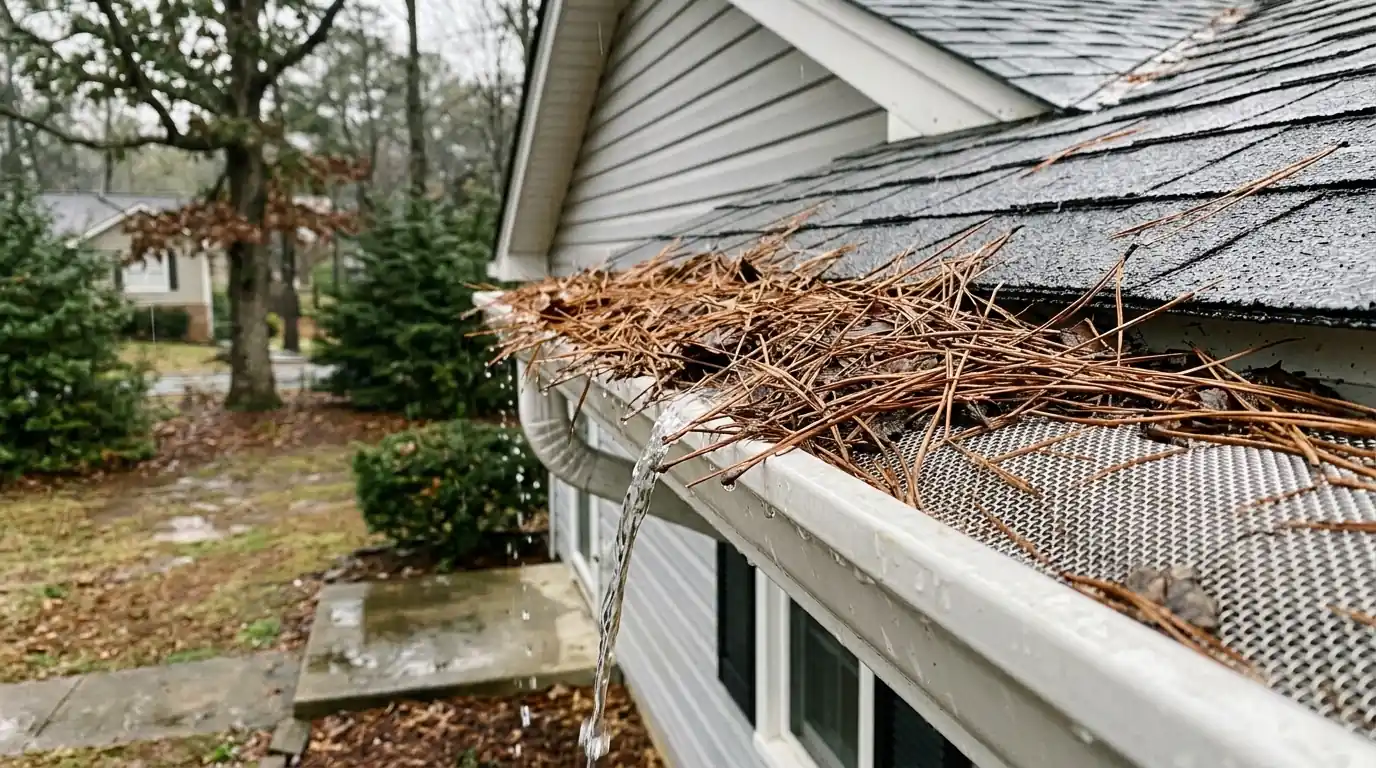
It is the signature guard failure under pine cover, and it means the guard is the wrong one for those trees rather than that guards do not work.
Written by Everett Sandlin, Lead Gutter Technician. Reviewed by Boyd Kessinger, Installation Supervisor. Last updated 2026-08-12.
Short answer
A pine needle is narrow enough to enter almost any screen opening and stiff enough to span one, so it either drops through or sits on top. Sitting on top is worse: needles interlock into a mat, water runs across the mat and straight over the front edge, and the trough underneath stays bone dry. The workable answer under pine is fine mesh with a surface that sheds rather than grips.
Why needles are the hardest debris there is
Broad hardwood leaves are the easy case. Almost any guard sheds oak and maple leaf, because the debris is simply larger than the openings and wind moves it off.
Needles are the opposite. They are small enough to find gaps, stiff enough to bridge them, and light enough to accumulate without ever washing clear. Geometry rather than volume is what defeats the guard.
Once a mat forms it behaves like a roof. Water sheets across it and leaves at the front lip, which is why the complaint sounds impossible: overflowing gutter, empty trough.
What a coarse screen does instead
A coarse screen lets needles through to the trough, which sounds like failure and is actually the less damaging outcome. The water still ends up in the gutter, and you are back to an ordinary cleaning problem.
The catch is where the needles end up. Fine stiff material travels along a trough and knits at the outlet, so a coarse screen under pine tends to move the blockage from the surface to the opening.
That is why neither extreme works well here. Too coarse and you have an outlet problem; too fine and you have a bridging problem.
What actually copes
Fine mesh with a smooth shedding surface, set at a pitch that lets needles slide rather than settle, is the arrangement that performs under Knoxville pine. The surface matters as much as the opening size.
Fitting matters too. Guards that sag, lift at the edge or are cut badly around a miter collect at exactly those points, and a system installed carelessly performs worse than no system at all.
None of it eliminates maintenance. It converts three cleanings a year into one inspection, which is a real saving and is not the same as never looking again.
Checking a guard you already have
The only reliable check is to lift a section and look. A guard hides the gutter, so a guarded trough nobody has seen for fifteen years is a trough nobody knows anything about.
Trees are the variable that changes underneath it. A system specified in 2005 was chosen for a canopy that is now twenty years larger, and a guard that was adequate can simply have been outgrown.
Some older systems were fastened under the first shingle course, which was common practice then and is not now. Where that has been done, replacing the guard is the chance to correct it.
What a guard cannot do for you
A guard sits above the trough, so everything below it stays exactly as it was. If the run has lost its fall, water still ponds. If the elevation is undersized, it still overflows. If the fascia behind it has softened, the hangers still let go.
That is worth saying because guards are frequently sold as a solution to problems they cannot touch. A guard fitted to a run that does not drain simply hides a fault that was already there and makes it harder to see.
The sensible sequence is to prove the run first. Clear it, flush it, check the fall and look at the board, and fit the guard once the thing underneath is known to work. Doing it the other way round buys a tidy looking roof edge with the same problem underneath.
It also affects what the guard costs you later. Removing and refitting a guard to reach a run that needs work adds time to every subsequent visit, so it is genuinely cheaper to sort the trough before covering it.
What to take from this
- Water over a dry gutter means a bridged mat, not a blocked trough
- Needles enter fine openings and bridge coarse ones, so both extremes fail
- Fine mesh with a shedding surface and correct pitch is the workable answer
- A badly fitted guard performs worse than no guard
- Guards convert cleanings into inspections rather than removing maintenance
- Lift a section and look before assuming an existing guard is working
Questions this raises
Under heavy cover, yes. They cut the work substantially. The failure people describe is almost always a guard mismatched to the debris rather than the concept failing.
No. Coarse screens pass them to the outlet and very fine mesh lets them mat on top. Surface and pitch matter as much as opening size.
You need inspection. Most guarded homes here move from three cleanings a year to one check, which is the real saving.
Have a section lifted and the trough looked at. Nothing about a bridged mat is visible from the ground or from inside.
Services this relates to
Gutter Guard Installation
Systems chosen for the debris your trees actually drop.
Gutter Cleaning Service
Clearing the trough before any guard goes on.
Gutter Inspection Service
Lifting a section to see what is underneath.
Roof Debris & Leaf Removal
Needles on the roof plane wash down at every storm.
Gutter Maintenance Plans
An annual check is what replaces the cleaning schedule.
Find out what your guards are doing
Tell us what stands over the roof and roughly when the guards were fitted.