Why your clean gutters still overflow
If a run is clear and still spills in every heavy storm, the problem is capacity. No amount of cleaning changes an undersized system.
Written by Landon Crutchfield, Senior Estimator. Reviewed by Boyd Kessinger, Installation Supervisor. Last updated 2026-08-12.
Short answer
Five inch K style with two by three inch downspouts handles a typical Knoxville ranch or bungalow. It stops being enough once roof area grows, pitch steepens or valleys concentrate flow at one point. On large two story roofs, six inch trough with three by four inch leaders is usually the right specification, and the leader size matters as much as the trough because a wide gutter draining through narrow downspouts still backs up.
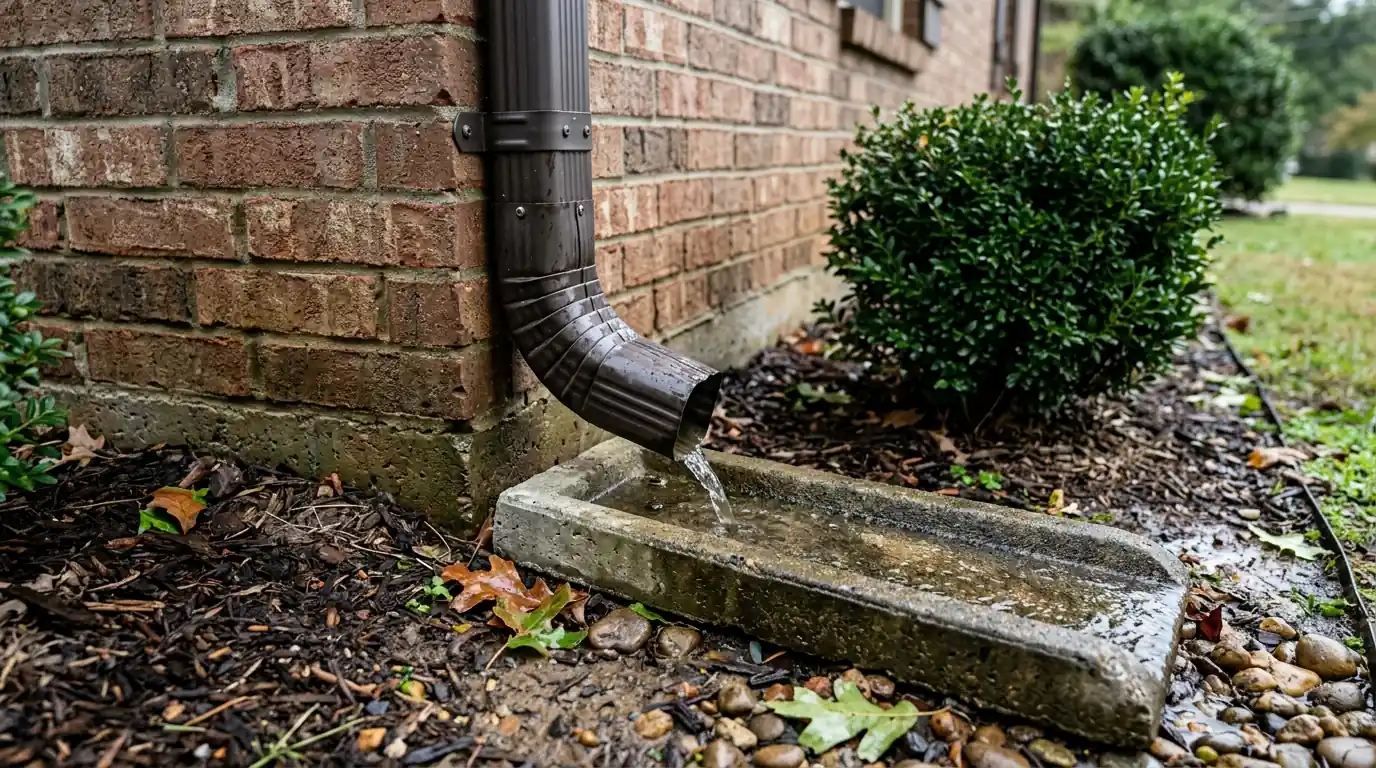
Three things decide the size, and area is only one
Roof area sets the volume. That much is obvious and it is the figure most people reach for, but on its own it is misleading.
Pitch sets the speed. A steep roof delivers the same rainfall to the trough far faster than a shallow one, so peak flow through each leader is higher even though the daily total is identical.
Valleys concentrate both. Where two roof planes meet, a wide catchment funnels into a channel a few inches across, and the water arrives at one point with real momentum. Two roofs of the same square footage can need completely different systems if one is a simple rectangle and the other has three valleys.
The leader is the restriction, not the trough
Water leaves a gutter only as fast as the downspouts can take it, so the outlet is the bottleneck on most systems rather than the trough itself.
That is why upsizing a gutter without upsizing the leaders achieves less than people expect. A six inch trough feeding two by three inch downspouts will still back up in a Knoxville summer storm, because the restriction never moved.
Count matters as much as size. The working limit is roughly one leader per thirty five feet of run, and closer than that where the roof above is steep or heavily valleyed. Plenty of houses here carry half the leaders they should.
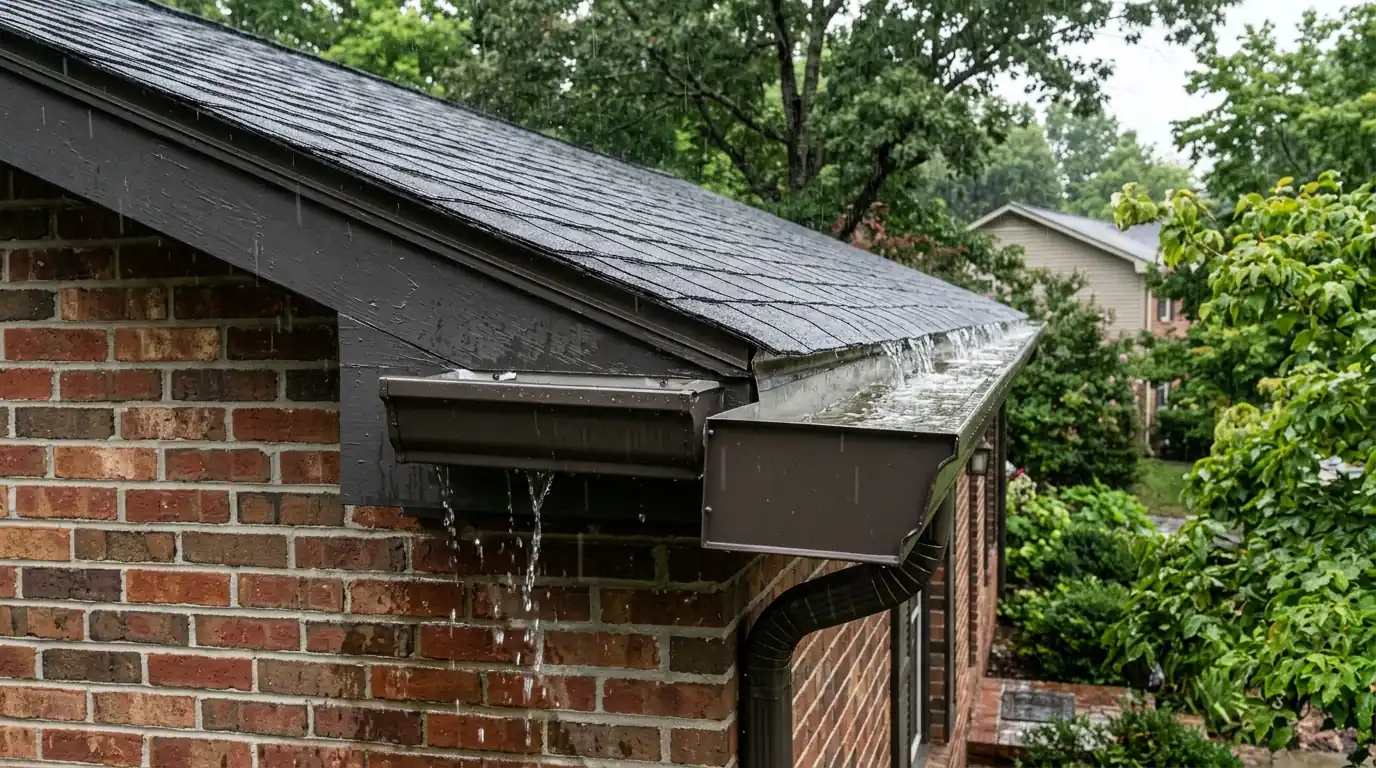
Where the shortfall shows up in Knoxville
The clearest pattern is west of the city. Modern subdivision houses in Hardin Valley, Farragut and Gettysvue carry large steep roofs on builder standard five inch trough with two leaders, and they overflow in every serious storm no matter how clean they are.
The opposite pattern sits in the older neighborhoods. Prewar houses generally have adequate sizing for their modest roofs, and their problems are fasteners, fall and the board behind the run rather than capacity.
In between are the houses that were extended. Where an addition added roof area without adding capacity, the run overflows at the join, and that gets mistaken for a blockage more often than anything else we see.
How to tell capacity from everything else
The test is simple. If the run is clear, the fall is correct and it still spills in heavy rain, the system is undersized. If it spills at one point only, look above that point for a valley. If it holds water after being flushed, that is pitch rather than capacity.
Timing helps too. A capacity problem appears in the heaviest storms and behaves perfectly in ordinary rain. A blockage gets worse steadily and often fails in light rain as well.
Where the overflow is always in the same place, the cause is almost never the whole system. Concentrated flow from a valley or a low point in the run accounts for the large majority of single spot overflow.
What upsizing actually involves
On a modern house it is usually a clean job. Fascia on recent construction is generally sound and the runs are correctly hung, so the work is forming new trough and fitting more leaders rather than repairing anything.
On older houses it frequently uncovers board work. A run coming off after decades exposes fascia that has been wet behind a sagging gutter, and that gets quoted separately because nothing behind an old run can be assessed until it is off.
Discharge belongs in the same conversation. Upsizing a trough without moving the discharge simply delivers more water to the same wrong place, which on clay backfill is the zone that should stay driest.
What to take from this
- Roof area, pitch and valley count together decide the size, not area alone
- The downspout is usually the restriction rather than the trough
- Roughly one leader per thirty five feet of run, and more where a valley lands
- Clean run plus correct fall plus overflow in heavy rain equals undersized
- Overflow in one place always means look above that spot for a valley
- Six inch trough on two by three inch leaders solves very little
- Upsizing without moving the discharge just delivers more water to the wrong place
Questions this raises
On a large steep two story roof in Knoxville, usually yes, together with three by four inch leaders. On a single story ranch, five inch is normally adequate.
Rarely. Overflow at a single point almost always means a valley lands there, and an outlet close to it does more than extra capacity along the whole run.
Frequently yes, and it is much the cheaper answer. A new outlet is cut into the existing trough and the leader hung from there.
They often are. Builder allowances are set before anyone measures the roof, so five inch goes on regardless of area, pitch or valley count.
Services this relates to
Gutter Replacement Service
Moving from builder five inch to six inch where the roof needs it.
Downspout Installation
Correcting leader count and size, often the cheaper fix.
Roof Valley Drainage Repair
Where a valley lands is where single spot overflow starts.
Seamless Gutter Installation
New runs formed to length once the sizing is settled.
Underground Downspout Drainage
Where the larger volume goes once it leaves the leader.
Get the roof measured properly
Tell us where it overflows and we will calculate what the elevation actually needs rather than guessing from the footprint.