When repairing a gutter stops being worth it
Most sagging gutters have nothing wrong with the metal. Knowing which ones do is the difference between a few hundred dollars and a few thousand.
Written by Landon Crutchfield, Senior Estimator. Reviewed by Boyd Kessinger, Installation Supervisor. Last updated 2026-08-12.
Short answer
A gutter is worth repairing while the trough itself is straight and unperforated. Sags, backed out spikes, open miters, lost pitch and split seams are all fixable in place for a fraction of a new run. Replacement becomes the honest answer once the metal is rusted through, the profile is bent along its length, the fascia behind it has failed, or the run is simply too small for the roof above it.
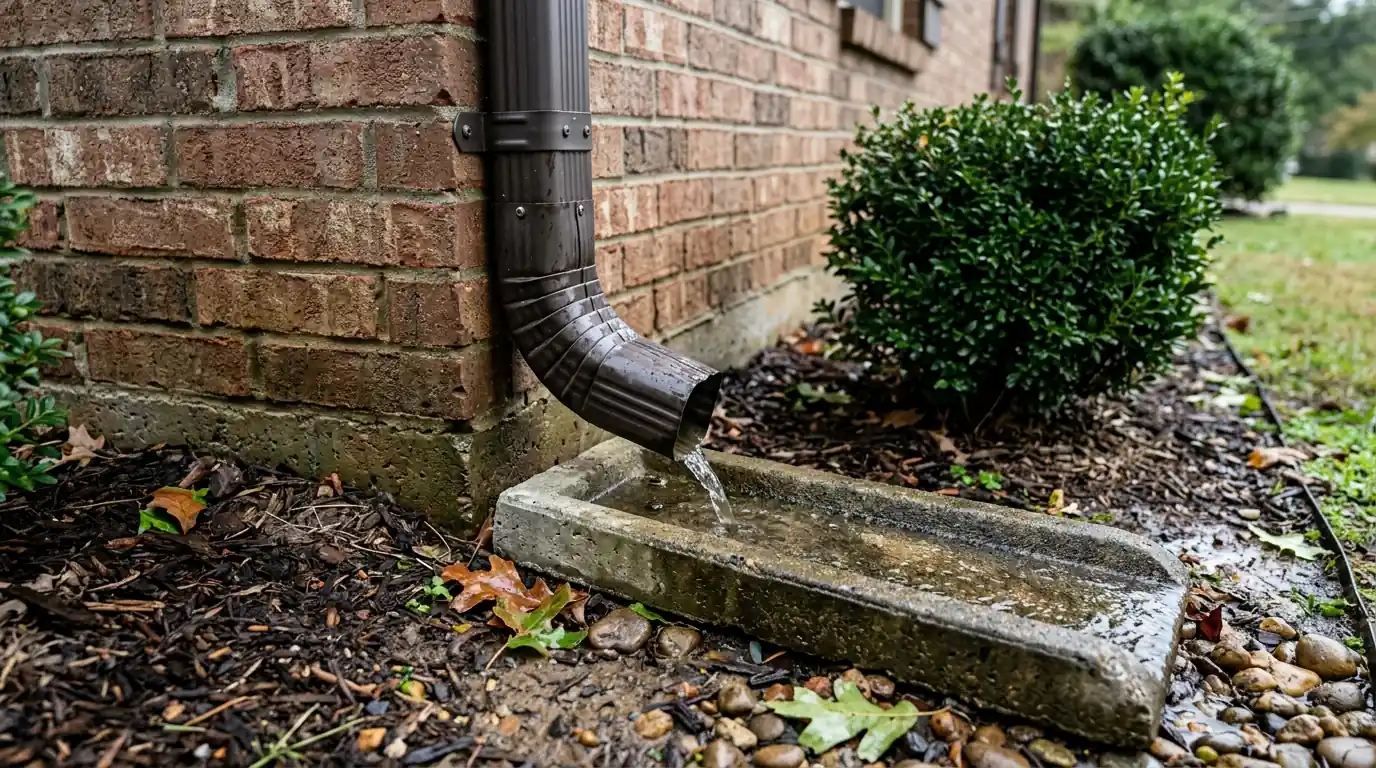
The four things that mean replace
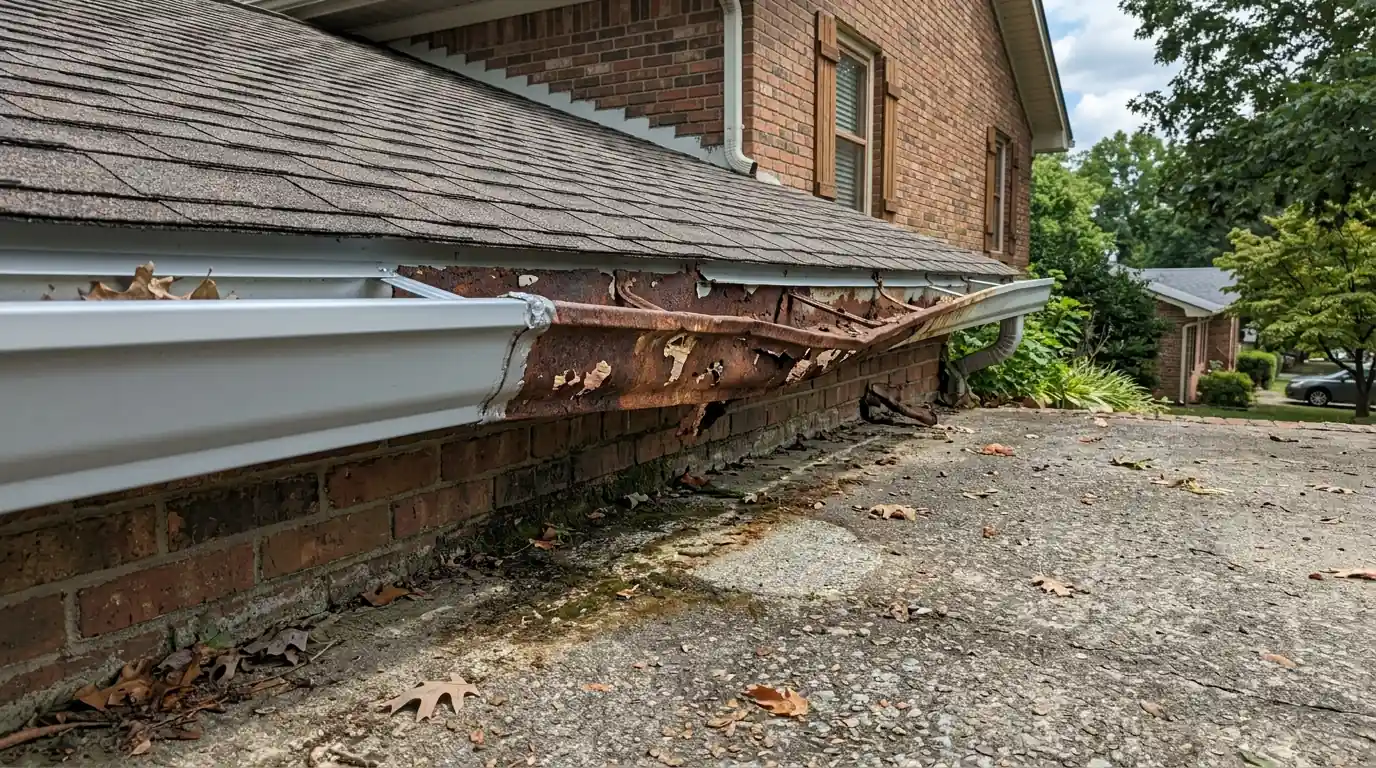
Perforation is the clearest. Once a steel run has rusted through at a seam, the coating has failed generally and the seams either side are a couple of years behind. Patching moves the leak rather than ending it.
Deformation is the second. A trough folded or bent along its length by ice or a limb will never hold a clean line again, and no amount of rehanging changes that.
Undersizing is the third and the one people miss. A clean, correctly pitched run that still overflows in every heavy storm is not faulty, it is too small, and repairing it achieves nothing.
Repeated repairs are the fourth. Three service calls on one elevation in two seasons is the arithmetic telling you something.
What repair genuinely fixes
Fastener failure is the most common thing we correct and it is entirely repairable. Spikes work loose over decades and hidden hangers bend under wet debris load, but the trough above them is usually fine.
Lost pitch goes with it. Refastening is the natural moment to reset the fall, and the two together cost a fraction of replacement while solving both the sag and the standing water.
Joints are the third. Miters and end caps rely on sealant and sealant has a service life, so a dripping corner on sound metal is a maintenance item rather than a verdict on the system.
The part nobody can see from the ground
The fascia behind the run decides more than the gutter does. Sound board takes new fasteners and holds; soft board takes them and lets go within a season regardless of how good the metal is.
That is why a quote can change once a run comes off. Nothing behind an old gutter can be assessed until it is down, and on older houses the carpentry is frequently a larger item than the gutter that prompted the call.
It also flips the economics. Where board work is needed anyway, the marginal cost of new trough while everything is off is much smaller than doing it as a separate job later.
Doing it in stages
Replacing one elevation and repairing the rest is a legitimate approach and a common one. There is no requirement to treat a house as a single decision.
Where several elevations are close to the end, doing them together saves the setup cost of returning, so the sensible split is usually by condition rather than by budget alone.
What is worth not deferring is anything putting water into the structure. A missing leader, a run discharging at a wall, or soft fascia gets worse and more expensive on its own schedule.
What a proper assessment looks like
Anyone can tell you a gutter is sagging. What decides the answer is whether the trough is straight, whether the metal is sound at the seams, whether the fall is recoverable and whether the board behind will take a fastener.
Those are four separate checks and they need somebody on a ladder rather than standing underneath. A quote given from the ground is a guess dressed up, and it is usually padded to cover the guess.
Water is the last check. Flushing a run shows whether it drains fully, where it ponds and whether the discharge reaches the ground where it should, and none of that is visible without it.
If a contractor recommends replacement without doing those things, ask which of them failed. It is a fair question and the answer tells you a great deal.
What to take from this
- Straight and unperforated trough is worth repairing whatever its age
- Rusted through, bent along its length, or undersized means replace
- A clean run that still overflows is a capacity problem, not a fault
- Most sagging gutters are a fastener problem with sound metal above
- The board behind the run frequently costs more than the gutter
- Elevation by elevation is a legitimate way to do it
- Never defer anything putting water into the structure
Questions this raises
Aluminum commonly serves twenty years or more here when cleared on schedule. Failure usually starts at the fasteners or the fascia rather than the metal.
Usually not. If the trough is straight and unperforated, converting to hidden hangers on fresh bite keeps the existing run for a fraction of replacement.
Because nothing behind an old run can be assessed until it is down. Soft fascia is the usual finding and it is quoted separately for that reason.
Yes, and it is often the sensible spend. Color matching across elevations is worth discussing before deciding.
Services this relates to
Gutter Repair Service
Where the trough is sound and something else has failed.
Gutter Replacement Service
When the metal itself has reached the end.
Gutter Hanger Replacement
Converting spikes to hidden hangers on fresh bite.
Fascia & Soffit Repair
The board a gutter hangs from, put right first.
Gutter Slope Correction
Resetting fall while the line is already lifted.
Get an honest answer either way
Describe what the run is doing and we will tell you which side of the line it falls on.