What seamless gutters actually change
The word gets used as a quality claim. It describes how a run is formed, and the difference it makes is real but narrower than the marketing suggests.
Written by Everett Sandlin, Lead Gutter Technician. Reviewed by Boyd Kessinger, Installation Supervisor. Last updated 2026-08-12.
Short answer
A sectional gutter is joined every ten feet and every joint relies on sealant, which has a service life. A seamless run is formed from one continuous coil on your driveway, so the only openings are the outlets, the end caps and the corner miters. It removes most of the failure points. It does not change sizing, fall, hanger spacing or where the water goes afterward, and those decide more than the seams do.
Where the leaks actually happen
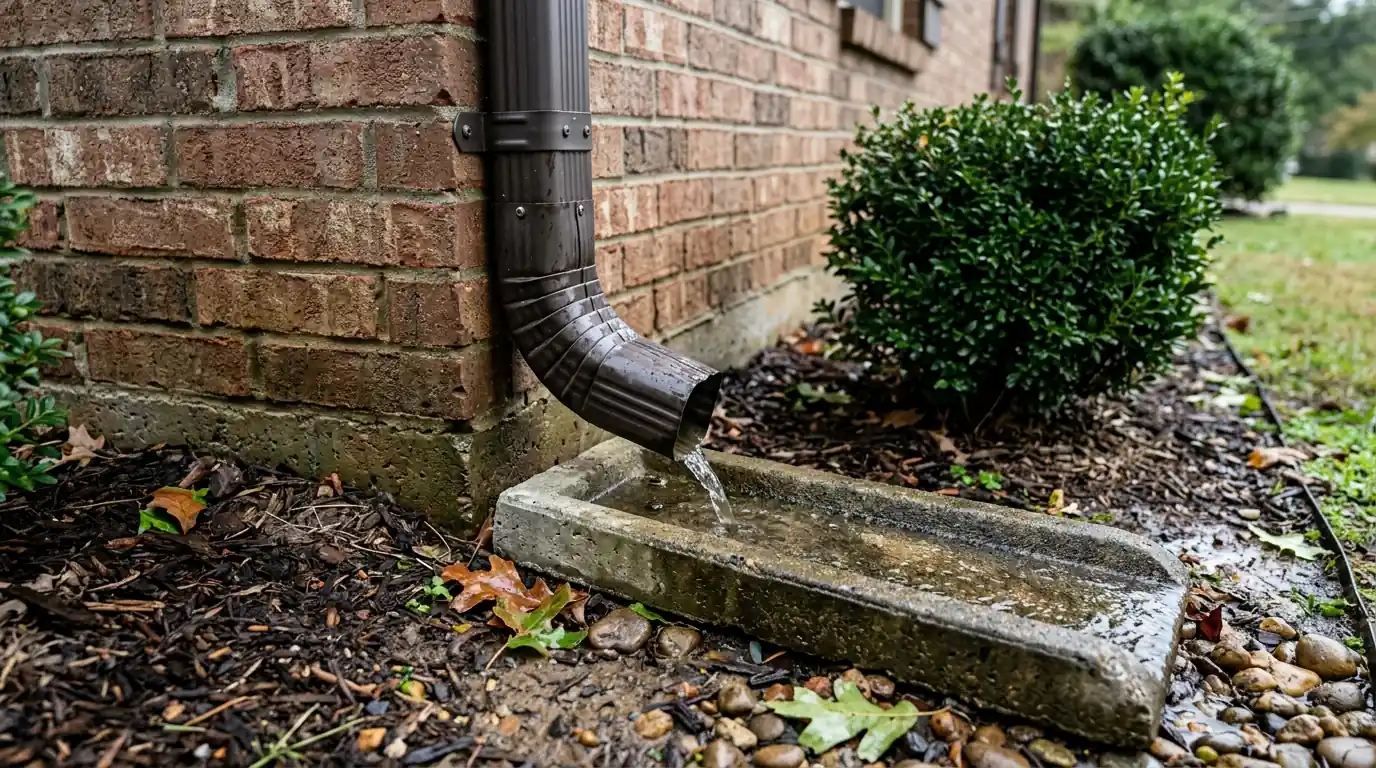
On a sectional run the lap joints are the weak points, and there are a lot of them. A forty foot elevation carries three or four joints that a seamless run would not have at all.
Each one depends on sealant, and sealant hardens and cracks through years of thermal movement. Once it goes, water escapes at the joint and runs down the back of the trough onto the fascia.
Seamless does not remove joints entirely. Corners, end caps and outlets are still sealed connections, so a seamless run has perhaps three or four sealed points where a sectional one has eight or ten.
What formed on site actually means
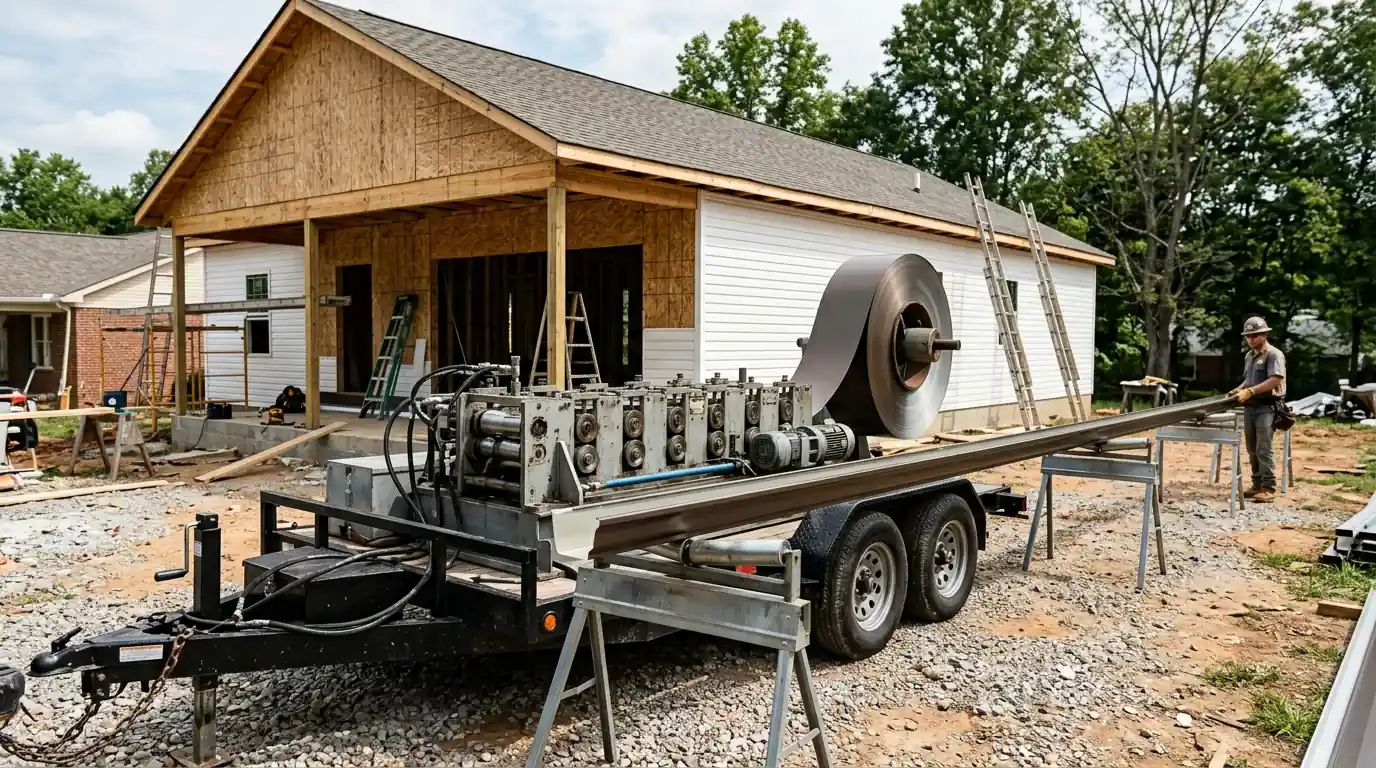
Coil arrives on a roll and runs through a forming machine mounted on a trailer. The machine shapes flat stock into a K style or half round profile at whatever length was measured.
That means the piece coming off is already correct for that elevation, with no cutting to fit and no joining to reach the far end.
It also means the color is factory baked onto the coil rather than painted afterward, which is why seamless aluminum runs hold their finish for decades with nothing to maintain.
What seamless does not fix
Sizing is unaffected. A seamless five inch run on a roof that needs six inch will overflow exactly as reliably as a sectional one would.
Fall is unaffected. A continuous run hung without proper pitch holds standing water just like any other, and standing water accelerates everything.
Hanger spacing is unaffected. A seamless trough hung at builder intervals under Knoxville canopy sags between fasteners the same way, because the load has not changed.
Drainage is entirely unaffected. Where the water goes after the downspout is a separate question and it is the one most Knoxville houses actually get wrong.
When sectional still makes sense
Small awkward sections sometimes suit it. A short run over a porch or a dormer can be made from stock without bringing a forming machine to the property.
Repairs on existing sectional systems are the other case. Where one length has failed on an otherwise sound run, matching a section is far cheaper than replacing the elevation.
Copper is different again. Copper systems are joined by soldering rather than formed continuously, and a soldered joint is stronger than a seamless run's sealed miter, so seamless is not the premium option there.
What actually decides how long a run lasts
Seams matter, but they come fourth on the list. Hanger spacing, fall, outlet count and the condition of the board behind all have more influence on how long a gutter serves than whether it was formed continuously.
Spacing is the one most often got wrong. Builder intervals assume a lighter debris load than a Knoxville autumn delivers, so a seamless run hung at those intervals sags between fasteners exactly like a sectional one would.
Fall is the second. A quarter inch for every ten feet toward the outlet is the working standard, and a continuous run without it holds standing water along its whole length rather than at a joint.
So the honest summary is that seamless is a genuine improvement on a well specified system and close to irrelevant on a badly specified one. It is worth having, and it is not what to judge a quote by.
What to take from this
- Sectional runs carry a sealed joint every ten feet; seamless carries three or four
- Seamless still has sealed corners, end caps and outlets
- Formed on site means correct length and factory baked color
- Seamless does not change sizing, fall, hanger spacing or drainage
- A seamless run that is undersized overflows just as reliably
- On copper, soldered joints beat seamless entirely
Questions this raises
On a long straight elevation, yes. Removing three or four sealed joints removes most of the points that eventually leak.
No. Seamless describes how the run is formed; aluminum is the material. Most seamless runs here happen to be aluminum.
Only if joints were the problem. If it overflows when clean, that is capacity and seamless changes nothing about it.
Yes. A damaged length is cut out and replaced, matched to the existing profile.
Services this relates to
Seamless Gutter Installation
Runs formed to length on your driveway.
Aluminum Gutter Installation
The default material for seamless work here.
Gutter Leak Sealing
Joints cut back to bare metal rather than sealed over.
Copper Gutter Installation
Where soldered joints beat seamless entirely.
Gutter Replacement Service
When the whole system is being renewed.
Price a seamless run
Tell us the elevations and we will measure, size and form them properly.