The Knoxville gutter cleaning calendar nobody follows
Most people book gutter cleaning for November. Under oak, the visit that prevents more overflow calls is the one in late May.
Written by Marla Whitehurst, Service Coordinator. Reviewed by Boyd Kessinger, Installation Supervisor. Last updated 2026-08-12.
Short answer
Two visits a year suits most Knoxville homes and three suits anything under heavy oak or pine. The timing matters more than the count. Oak catkins drop through April and May in enormous numbers, and those narrow stiff stems are what actually knit into a mat at an outlet. Whole leaves largely wash through. A late May visit clears the year's tassel load before the first serious summer storm tests it.

Why spring beats autumn under oak
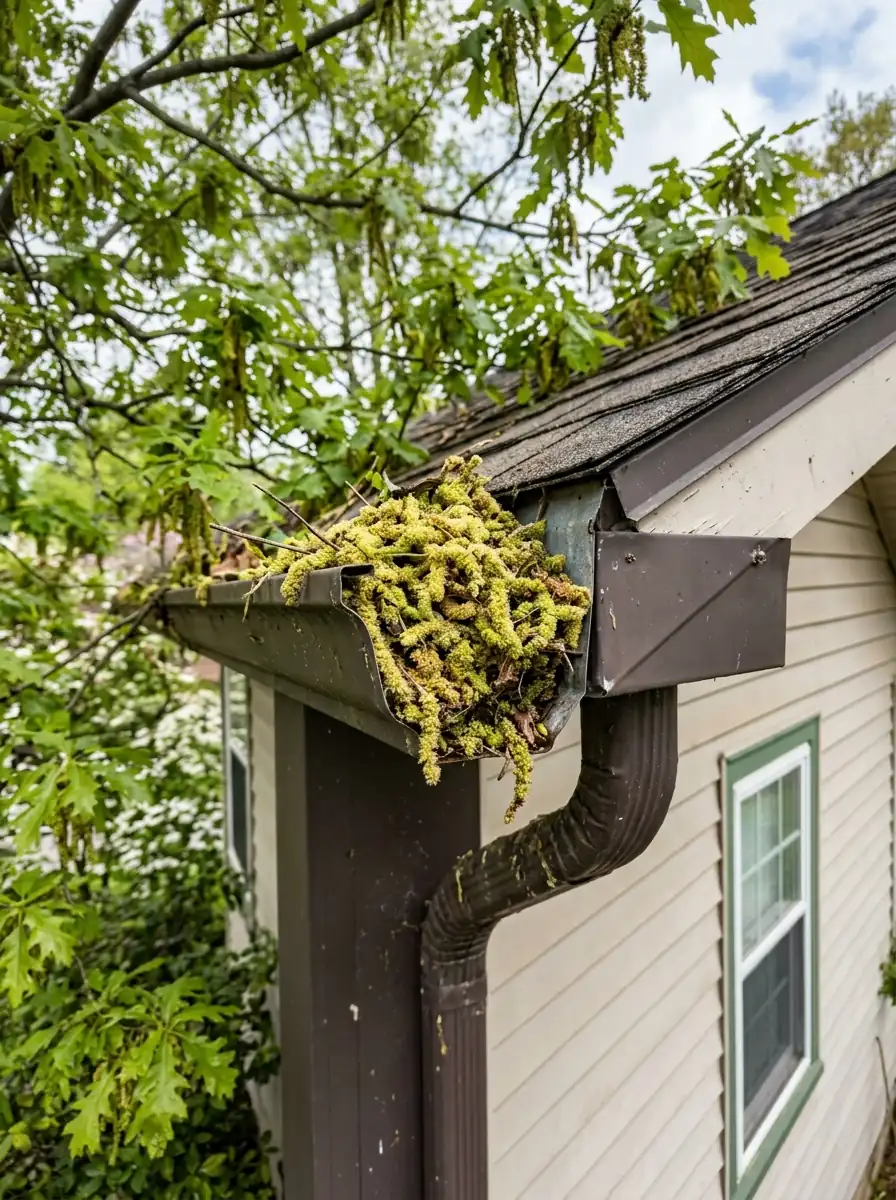
An oak catkin is a few inches long, narrow and stiff, and it behaves nothing like a leaf in a gutter. A leaf lies flat and either washes along the trough or sits harmlessly at the bottom of it.
A tassel travels easily along a run and then jams where the opening narrows. Once a few dozen have jammed at an outlet they interlock into a mat that water cannot pass, and that mat catches everything arriving behind it.
The result is the complaint we hear most in June: an overflowing gutter that looks perfectly clean from the ground. The trough genuinely is clear. The blockage is a fist sized wad of stems sitting in the outlet where nobody can see it.
What actually falls, and when
Spring is tassel and seed. Oak catkins through April and May, maple seed following close behind, and both are small enough to travel and stiff enough to jam.
Summer is quiet on most Knoxville properties, which is exactly why the spring visit holds. A run cleared in late May is generally still clear when the heaviest storms arrive in July and August.
Autumn is the volume. The hardwood drop here starts in October and runs late into November, which catches people out. An early October visit is nearly always too early and needs a second one to finish the job.
Pine and hemlock ignore all of this. Needles fall in every month of the year, so properties under conifer cover work to an even schedule rather than a seasonal one.
How many visits your house actually needs
Open ground with little tree cover manages on two a year, timed after the spring drop and after the hardwood fall finishes in late November.
Mixed hardwood cover, which describes most of the older Knoxville neighborhoods, needs three. Spring, mid autumn and a late autumn visit once the drop has genuinely stopped.
Heavy pine or hemlock needs four, spaced evenly rather than clustered. There is no season to work around when the load never stops arriving.
The tree cover over your roof matters far more than the size of the house. A small bungalow under three mature oaks needs more visits than a large house on open ground.
The outlet is the part that matters
Almost every overflow call turns out to be an outlet rather than a trough. The opening into the downspout is smaller than the gutter, so it blocks first, and a gutter can look clean from the ground while that opening is completely bridged.
That is why any cleaning worth paying for ends with water rather than with a look. Each outlet flushed and the discharge watched at grade is the only honest confirmation that the run will actually work in the next storm.
The same flush proves the fall. A run that holds standing water after being flushed has a pitch problem rather than a debris problem, and that is worth knowing in May rather than discovering in July.
What to do if you have guards
Guards change the schedule rather than removing it. A well matched guard cuts the load substantially, and most guarded homes here move from three cleanings a year to one inspection.
Under pine that inspection is not optional. Needles bridge across a fine mesh and shed water over the front edge while the trough underneath stays completely dry, and nothing about that is visible from inside the house.
If a guard was fitted more than fifteen years ago, the useful thing is to have a section lifted and the trough looked at. Some legacy systems have performed exactly as sold. Others have been quietly holding a compacted layer for years.
What to take from this
- Book the spring visit for late May, after oak tassel drop has finished
- An early October autumn visit is usually too early and needs a second
- Two visits on open ground, three under hardwood, four under pine
- Tree cover over the roof decides the count, not the size of the house
- Any cleaning should end with water through every outlet, not just a look
- A run that ponds after flushing has a pitch problem rather than a debris one
- Guarded runs need an annual inspection rather than no attention at all
Questions this raises
On genuinely open ground with no trees overhanging the roof, sometimes. Under any meaningful canopy in Knoxville it is not, and waiting a full year is what turns a cleaning into a repair.
The risk is pushing material into the leader rather than pulling it out, which turns a five minute problem into a rodding job. Proving the outlet with water is the part most people skip.
Tassel drop. The autumn visit cleared last year's leaves and the spring catkins have since matted at the outlet.
Under pine, yes, and before the gutter. Needles held on a roof plane wash down at every storm and refill a cleared trough within weeks.
Services this relates to
Gutter Cleaning Service
The visit itself, cleared by hand with outlets proved.
Clogged Gutter Repair
When a blockage has already caused an overflow.
Gutter Guard Installation
Cutting the number of visits by keeping the load out.
Gutter Maintenance Plans
A schedule set by your trees rather than a standard package.
Roof Debris & Leaf Removal
Clearing the roof before the gutter, in that order.
Book the visit that actually matters
Tell us what stands over the roof and we will tell you how many visits your house genuinely needs.