Four feet is not a drainage plan
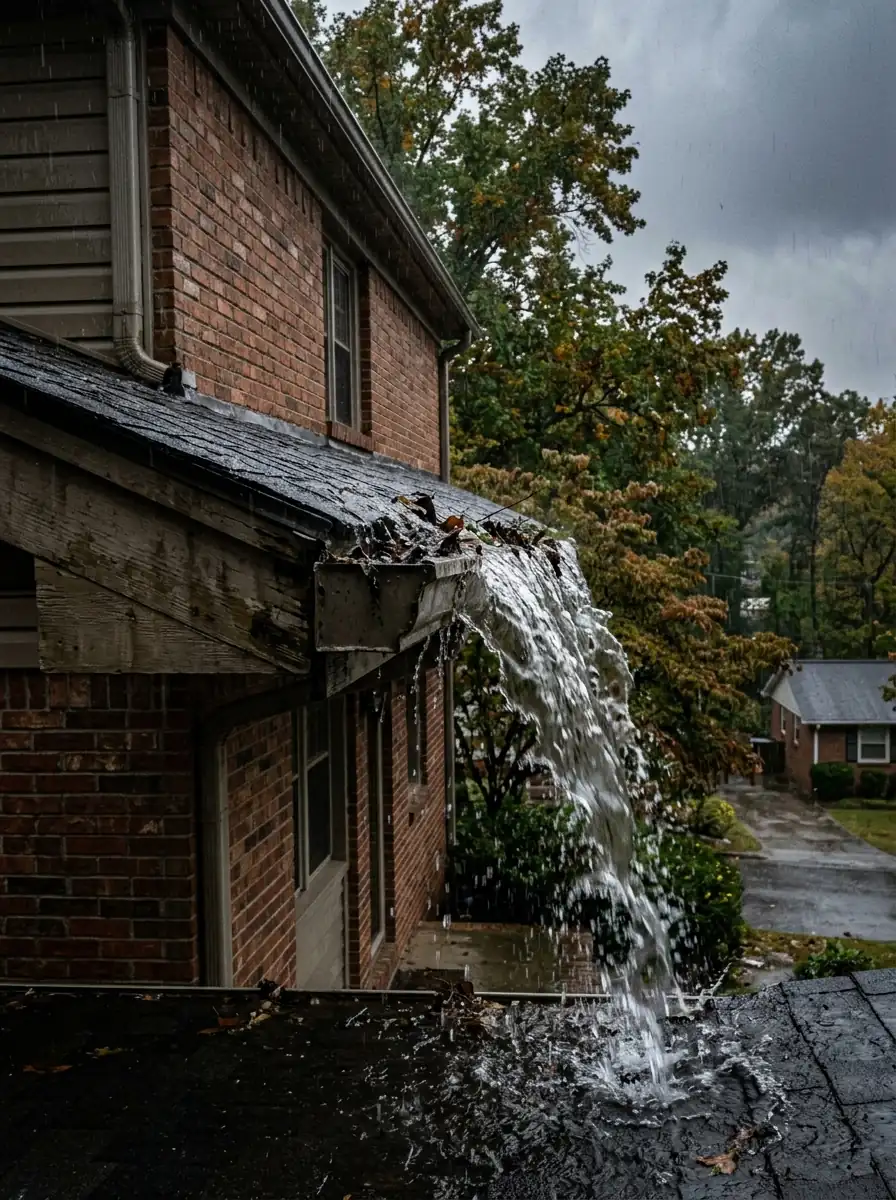
Most Knoxville homes release the entire roof into the one strip of ground that should stay driest, and a splash block is what makes it look deliberate.
Written by Everett Sandlin, Lead Gutter Technician. Reviewed by Boyd Kessinger, Installation Supervisor. Last updated 2026-08-12.
Short answer
Roof water needs to clear the backfill zone around the foundation, which on Knox County clay usually means well beyond the four foot splash block most houses have. Clay absorbs slowly, so water released close in sits in the disturbed fill rather than soaking away. How far is enough depends on the grade: on ground that falls away, six to eight feet may do it; on flat ground the water has to reach somewhere that can actually take it.
What the backfill zone is and why it matters
When a foundation goes in, the ground around it is excavated and then pushed back. That fill is looser than the undisturbed soil beside it, no matter how well it was compacted at the time.
Looser ground accepts water more readily, which means the strip immediately around your house is the easiest path down for anything released there. That is the opposite of what you want.
It also settles over years, which is why the ground near a wall frequently ends up level with or falling toward the house rather than away from it.
Why clay changes the arithmetic
Red clay holds water rather than passing it. Rainfall landing on a lawn soaks in gradually, but a downspout delivers a roof's worth to one spot in minutes, and clay cannot take it at that rate.
So the water sits, spreads sideways along the surface, and finds the loosest ground available. On most properties that is the backfill.
The practical consequence is that distance matters more here than gradient. Getting the discharge well away from the perimeter beats finding a slight fall close in.
Extensions, buried lines and which suits
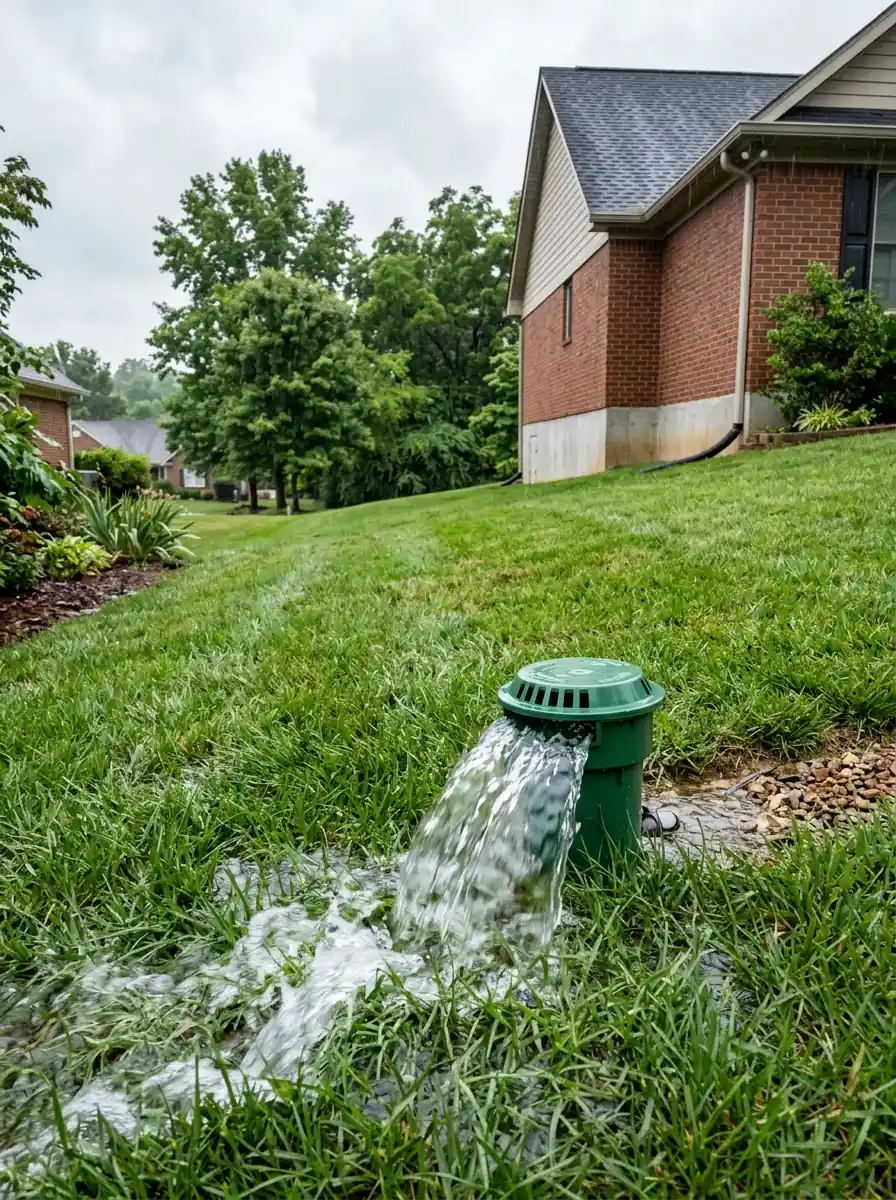
An extension is cheap, reversible and visible. It moves discharge further out with no digging, and on a lot that falls away it is frequently the whole answer.
A buried line goes further, survives mowing and disappears from view. On flat lots, long runs, or anywhere the route crosses ground you actually use, it earns its extra cost.
The deciding question is usually where the water can end up. A buried line needs a discharge point that can accept volume, and identifying that comes before choosing a route.
The mistake worth avoiding
The common error is connecting roof water into a French drain. Those are built to collect groundwater slowly along their length, and roof volume overwhelms them in the first serious storm.
Properties needing both get two separate systems: solid pipe carrying roof water to a chosen outlet, and perforated pipe in gravel collecting what is held in the soil.
Keeping them apart is what makes each one work. Combined, the drain floods and the groundwater has nowhere to go, which is two jobs neither of which is finished.
Reading your own ground
You can learn most of what you need by watching one storm. Where water pools, where it runs, where the ground stays soft afterward and where mulch has migrated all tell you what the grade is actually doing rather than what it looks like on a dry day.
A trench forming below a leader means the ground falls away and the flow is concentrated, so distance and spreading are the answer. Standing water in the same spot means the opposite: the ground cannot take it and the water needs to go somewhere else entirely.
Soil built up above the slab or against the wall is worth noticing too. Beds raised over the years hold water exactly where you want it dry, and lowering them can achieve more than any pipe.
None of that requires equipment. Ten minutes outside in heavy rain tells you more about your drainage than an hour of looking at the gutters on a dry afternoon.
What to take from this
- The strip of loose backfill around a foundation is the last place to release water
- Clay cannot absorb a roof's worth of water delivered to one spot in minutes
- Distance matters more than gradient on flat Knoxville lots
- Extensions suit falling ground; buried lines suit flat lots and long routes
- Identify the discharge point before choosing a route
- Never connect roof leaders into a French drain
Questions this raises
Far enough to clear the backfill zone, which on clay means well past a four foot splash block. The grade decides how much further.
On ground that falls away from the house, frequently yes. On flat ground the water has to reach somewhere that can take it, which usually means burying the line.
Best not to. Roof volume overwhelms a system built to collect groundwater slowly, and both then underperform.
Often it is most of the fix, because most crawlspace water here arrives from the roof rather than the water table.
Services this relates to
Downspout Extension Installation
The simplest way to move discharge clear of a wall.
Underground Downspout Drainage
Carrying roof water below ground to a chosen outlet.
French Drain Installation
For water held in the soil, kept as its own system.
Yard Drainage Correction
Reshaping ground where the surface is the problem.
Downspout Installation
Leader placement decides where the volume lands.
Find out where your water should go
Tell us where it pools or cuts and we will walk the grade before recommending anything.