Mild winters still break gutters
East Tennessee does not get a severe winter, which is exactly why freeze damage surprises people when it arrives.
Written by Marla Whitehurst, Service Coordinator. Reviewed by Boyd Kessinger, Installation Supervisor. Last updated 2026-08-12.
Short answer
Freeze damage is not really about cold. It is about water that was still sitting in the gutter when the temperature dropped, which means every freeze problem started as a drainage problem weeks earlier. Ice is far heavier than the water it came from and it expands, so a run holding standing water in December gains a rigid load and works its joints open. A run that drains fully has nothing left in it to freeze.
The three things ice does
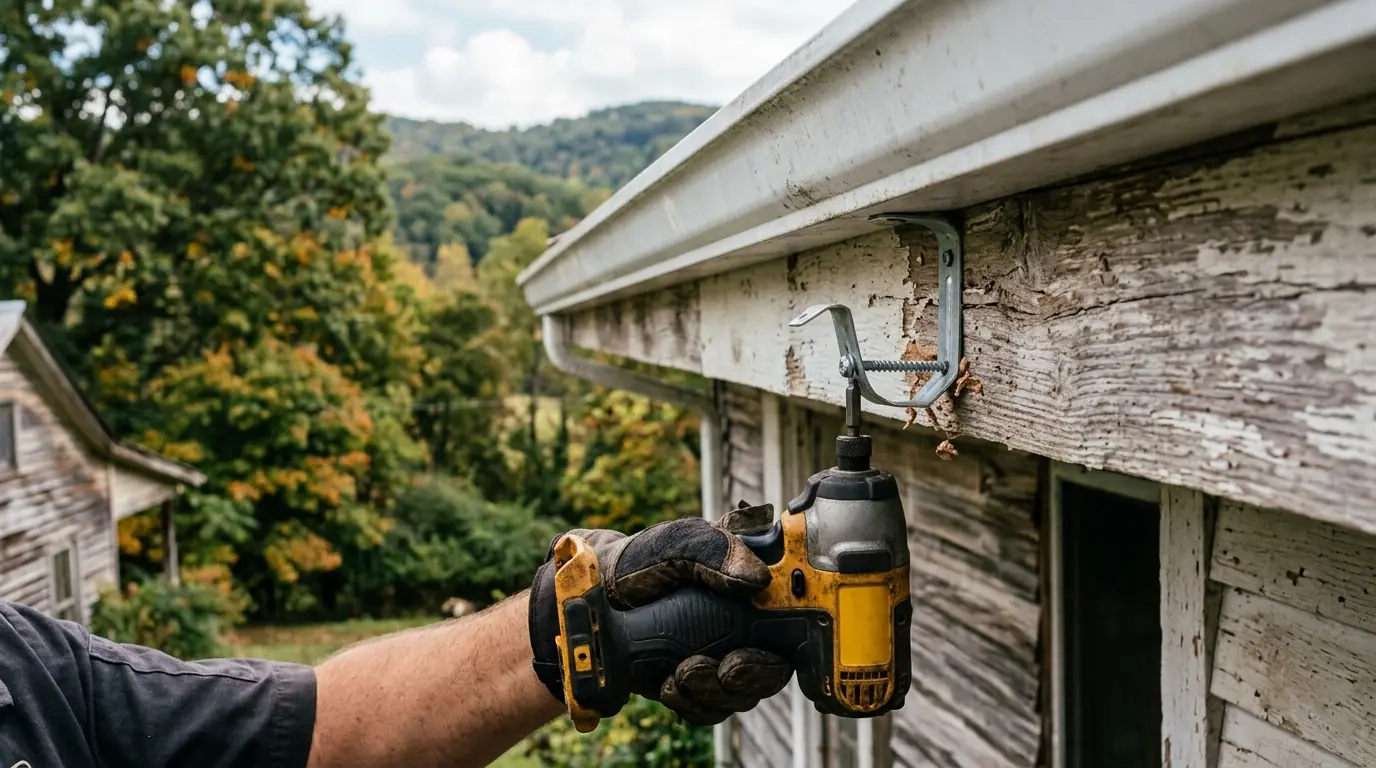
Weight is the first. Ice is substantially heavier than the equivalent water and it does not move, so a trough that was coping with a manageable load suddenly carries a rigid one and hangers bend under it.
Expansion is the second. Freezing water grows, and in a confined trough that growth pushes outward against seams, end caps and miters. Joints that water alone would never have opened work loose after two or three cycles.
Blockage is the third. A partial obstruction that passes water in October becomes a complete one overnight in January, and the run backs up along its full length.
Why shade matters more than temperature
Knoxville rarely stays below freezing for long, so most elevations thaw and drain within a morning. That limits how much damage a single cold night can do.
Shaded elevations do not get that reset. Under canopy or on a north facing wall the sun never reaches the roof edge, so ice persists, partially melts in the afternoon, refills the low points and freezes again after dark.
That repeated cycling is what does the damage. One freeze is survivable; the same water freezing five times in a week is what opens joints and bends fasteners.
The pre winter visit is the whole answer
A run that is clear and correctly pitched going into December holds no standing water, and a gutter with nothing in it has nothing to freeze. That is the entire prevention strategy.
Timing matters because the hardwood drop here runs late into November. A visit in early October clears last season rather than this one, so the useful appointment is late November or early December.
It is also the moment to catch pitch problems. A run that ponds after being flushed has a fall problem, and correcting it in December costs far less than replacing hangers in March.
Ground level is a safety question
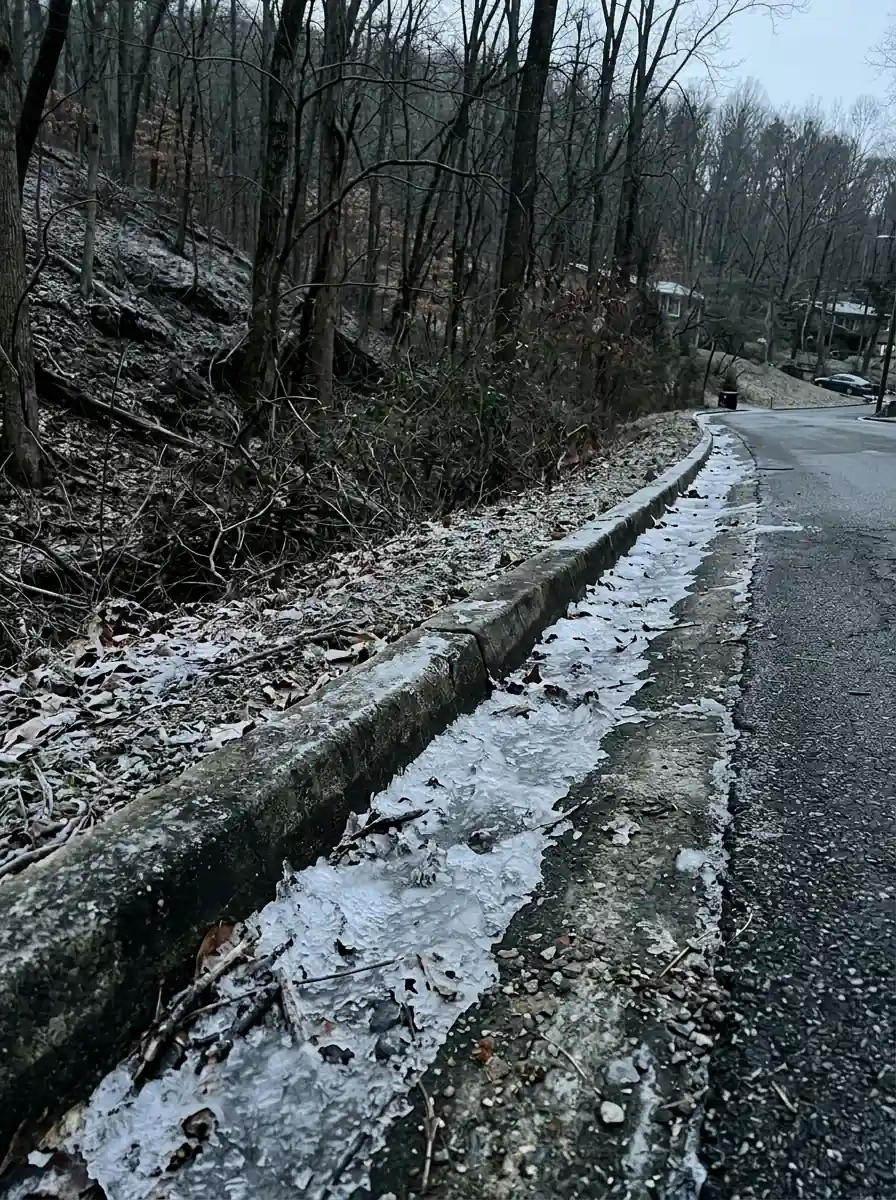
Discharge that lands on a path, a step or a driveway freezes there and stays frozen on shaded elevations. That is a slip hazard rather than a drainage inconvenience.
Moving the discharge point is usually straightforward and it is worth doing before the first cold spell rather than after somebody has slipped.
On commercial frontages this matters more again, because the ground below is used by the public rather than by the owner.
What to check after a cold spell
Look along the line first. A run that has carried ice frequently shows a dip that was not there in November, and that is the fasteners reporting on the load they took.
Then look at the corners and end caps. Expanding ice works joints open, and a seam that starts weeping in February usually froze in January rather than simply aging.
Check the ground below the leaders while you are at it. Discharge that iced and thawed repeatedly can undercut the point where it lands, and that shows as a hollow or a soft patch rather than as anything obvious.
None of that needs fixing urgently in most cases. It needs noticing, because a spring repair booked calmly costs less than the same repair booked after the first heavy summer storm finds the weakness.
What to take from this
- Every freeze problem starts as standing water weeks earlier
- Ice adds rigid weight and expands against joints
- Shaded elevations cycle repeatedly instead of thawing once
- The pre winter visit belongs in late November, not early October
- A run that ponds after flushing has a fall problem, not a debris one
- Discharge onto a shaded path is a slip hazard worth moving
Questions this raises
On shaded elevations, yes, and repeatedly. The canopy keeps sun off the roof edge, so a single cold night becomes several days of freeze and thaw.
Freezing water expands and pushes outward against the joint. Two or three cycles will open a seam that water alone would never have moved.
Late November or early December. The hardwood drop here runs late, so an early October visit clears the wrong season.
Rarely necessary at Knoxville temperatures. Getting the run draining fully addresses the cause instead of managing the symptom.
Services this relates to
Gutter Cleaning Service
Clearing before the cold, which is the whole prevention.
Gutter Slope Correction
A run that drains fully has nothing left to freeze.
Gutter Hanger Replacement
Refastening runs that carried ice load through a cold spell.
Gutter Leak Sealing
Joints that expanding ice has worked open.
Downspout Extension Installation
Moving discharge off a path before it ices.
Book the pre winter visit
Tell us which elevations sit in shade and we will make sure they drain before the cold arrives.